Showing posts with label emergency and disaster response. Show all posts

Friday, August 29, 2014

[MY POST ON @SchoolofData BLOG]: A WEEKEND OF DATA, HACKS AND MAPS IN NIGERIA

It was another weekend of hacking for good all around the world, and Abuja, Nigeria was not left out of the weekend of good, as 30 participants gathered at the Indigo Trust funded space of Connected Development [CODE] on 12 – 14 September, scraping datasets, brainstorming creating technology for good, and not leaving one thing out – talking soccer (because it was a weekend, and Nigeria “techies” love soccer especially the English premiership).
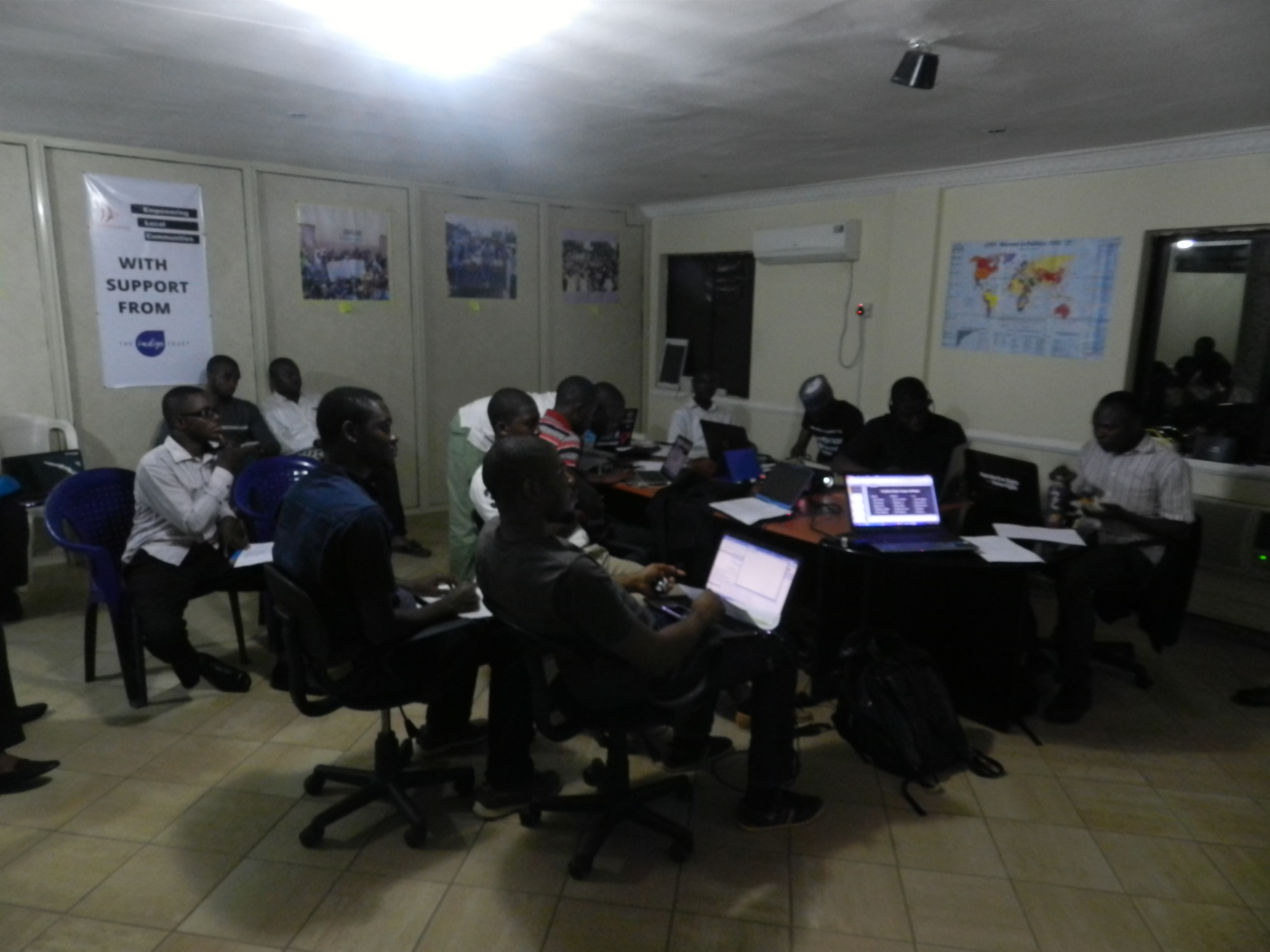
Participants at the Hack4Good 2014 in Nigeria
Leading the team, was Dimgba Kalu (Software Architect with Integrated Business Network and founder TechNigeria), who kick started the 3 day event that was built around 12 coders with other 18 participants that worked on the Climate Change adaptation stream of this year #Hack4Good. So what data did we explore and what was hacked over the weekend in Nigeria? Three streams were worked :
  1. Creating a satellite imagery tagging/tasking system that can help the National Space Research Development Agency deploy micromappers to tag satellite imageries from the NigeriaSat1 and NigeriaSat2
  2. Creating an i-reporting system that allows citizen reporting during disasters to Nigeria Emergency Management Agency
  3. Creating an application that allows citizens know the next water point and its quality within their community and using the newly released dataset from the Nigeria Millennium Development Goal Information System on water points in the country.
Looking at the three systems that was proposed to be developed by the 12 coders, one thing stands out, that in Nigeria application developers still find it difficult to produce apps that can engage citizens – a particular reason being that Nigerians communicate easily through the radio, followed by SMS as it was confirmed while I did a survey during the data exploration session.
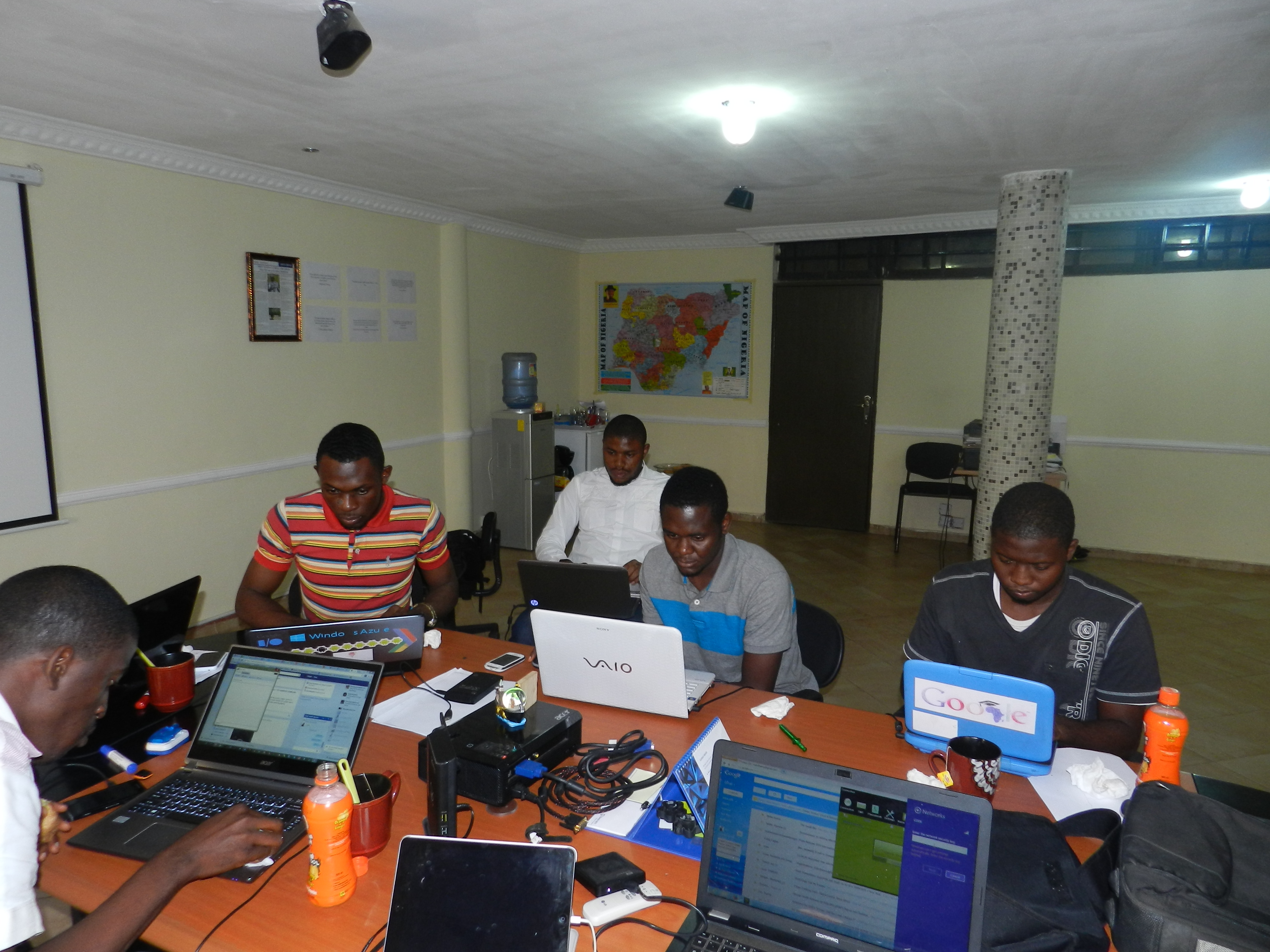
Coders Hackspace
Coders Hackspace
Going forward, all participants agreed that incorporating the above medium (Radio and SMS) and making games out of these application could arouse the interest of users in Nigeria.  “It doesn’t mean that Nigerian users are not interested in mobile apps, what we as developers need is to make our apps more interesting” confirmed Jeremiah Ageni, a participant.
The three days event started with the cleaning of the water points data, while going through the data pipelines, allowing the participants to understand how these pipelines relates to mapping and hacking. While the 12 hackers were drawn into groups, the second day saw thorough hacking – into datasets and maps! Some hours into the second day, it became clear that the first task wouldn’t be achievable; so much energy should be channelled towards the second and third task.
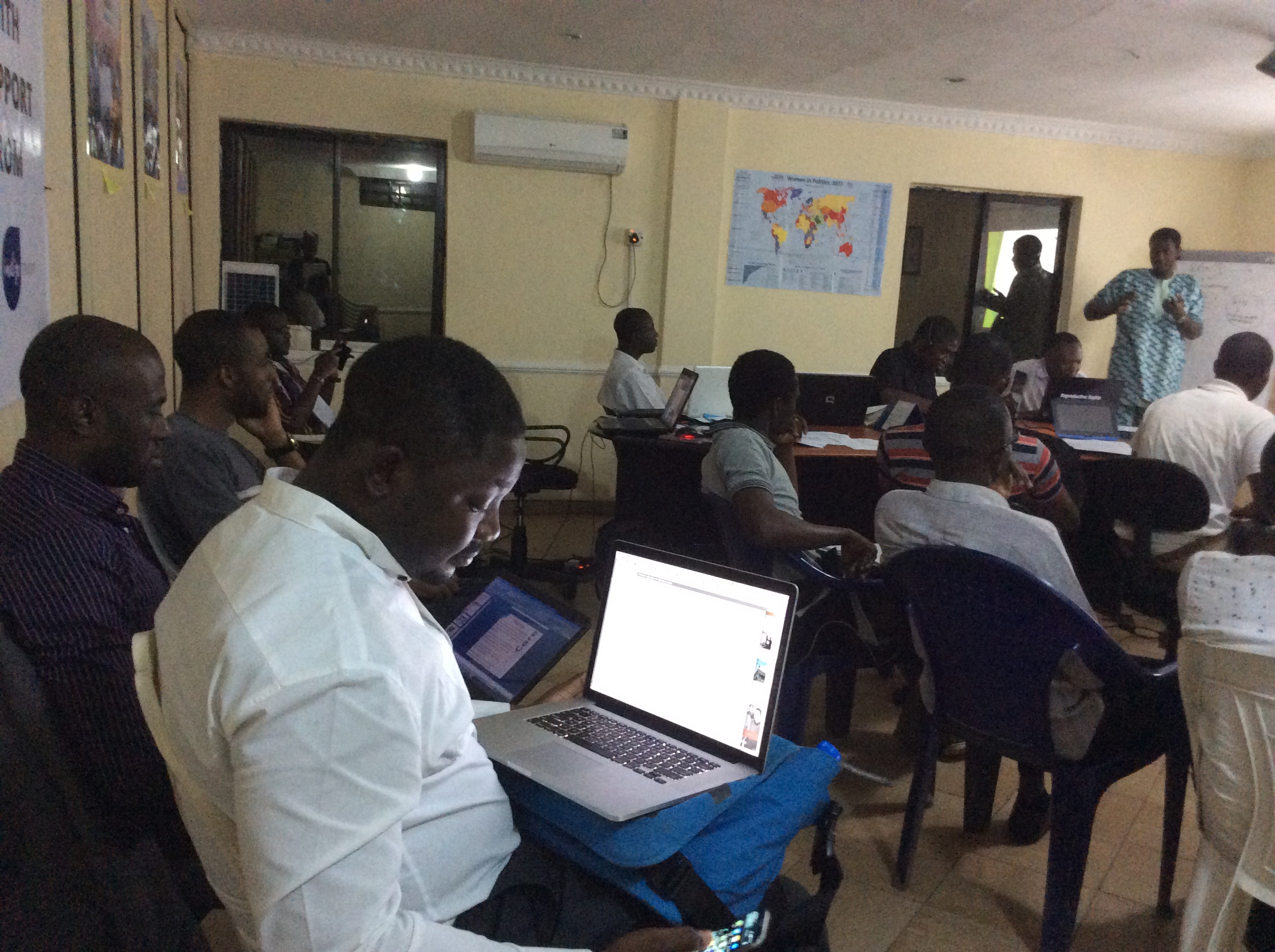
SchoolofData Fellow - Oludotun Babayemi taking on the Data Exploration session
SchoolofData Fellow – Oludotun Babayemi taking on the Data Exploration session
Hacking could be fun at times, when some other side attractions and talks come up – Manchester United winning big (there was a coder, that was checking every minutes and announcing scores)  , old laptops breaking (seems coders in Abuja have old  ones), coffee and tea running out (seems we ran out of coffee, like it was a sprint), failing operating systems (interestingly, no coders in the house had a Mac operating system), fear of power outage (all thanks to the power authority – we had 70 hours of uninterrupted power supply) , and no encouragement from the opposite sex (there was only two ladies that strolled into the hack space).
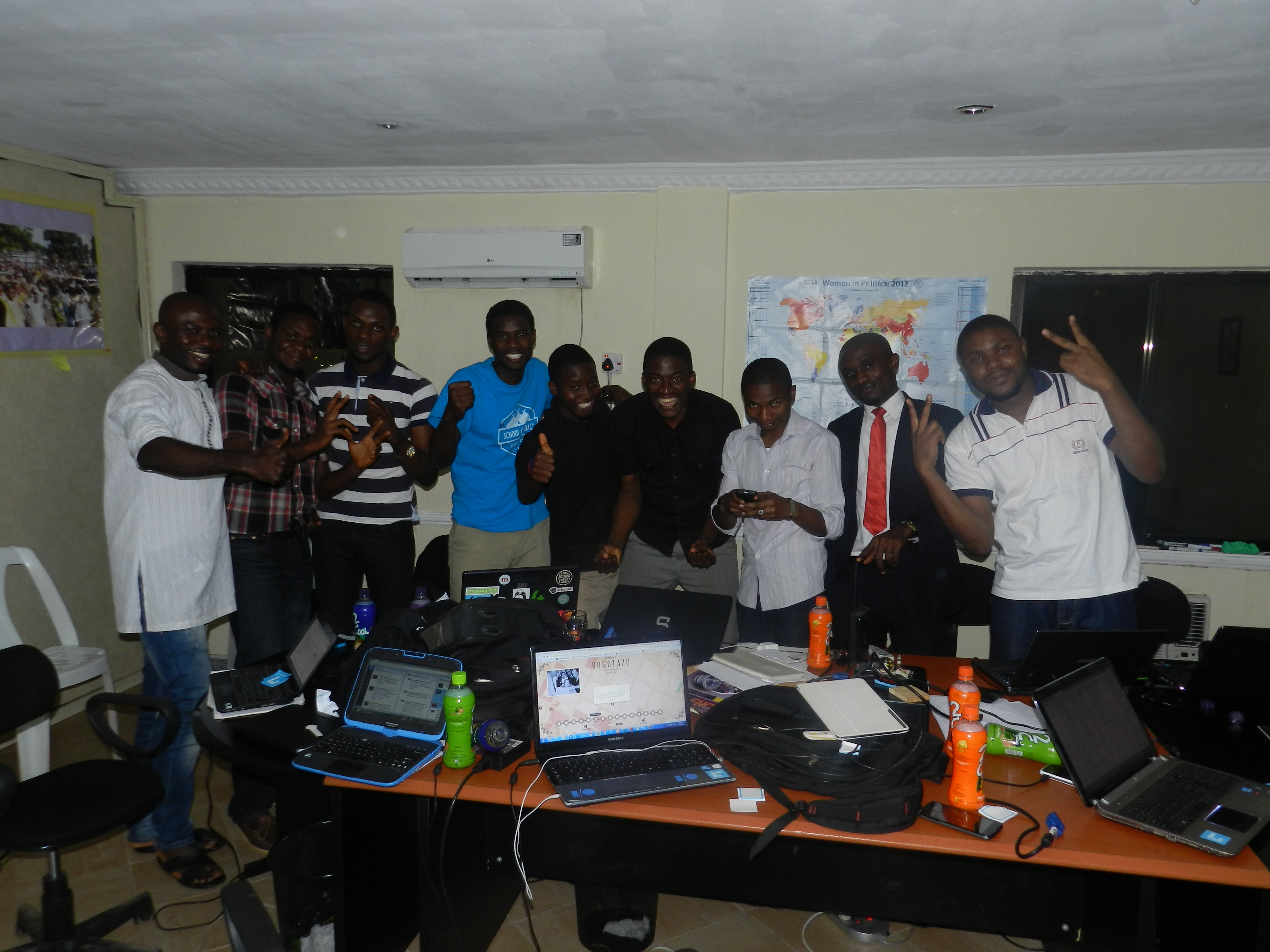
Bring on the energy to the hackspace
As the weekend drew to a close, coders were finalizing and preparing to show their great works.  A demo and prototype of streams 2 and 3 were produced. The first team (working on stream 2), that won the hackathon developed EMERGY, an application that allows citizens to send geo-referenced reports disasters such as floods, oil spills, deforestation to the National Emergency Management Agency of Nigeria, and also create a situation awareness on disaster tagged/prone communities, while the second team, working on stream 3, developed KNOW YOUR WATER POINT an application that gives a geo-referenced position of water points in the country. It allows communities; emergency managers and international aid organizations know the next community where there is a water source, the type, and the condition of the water source.
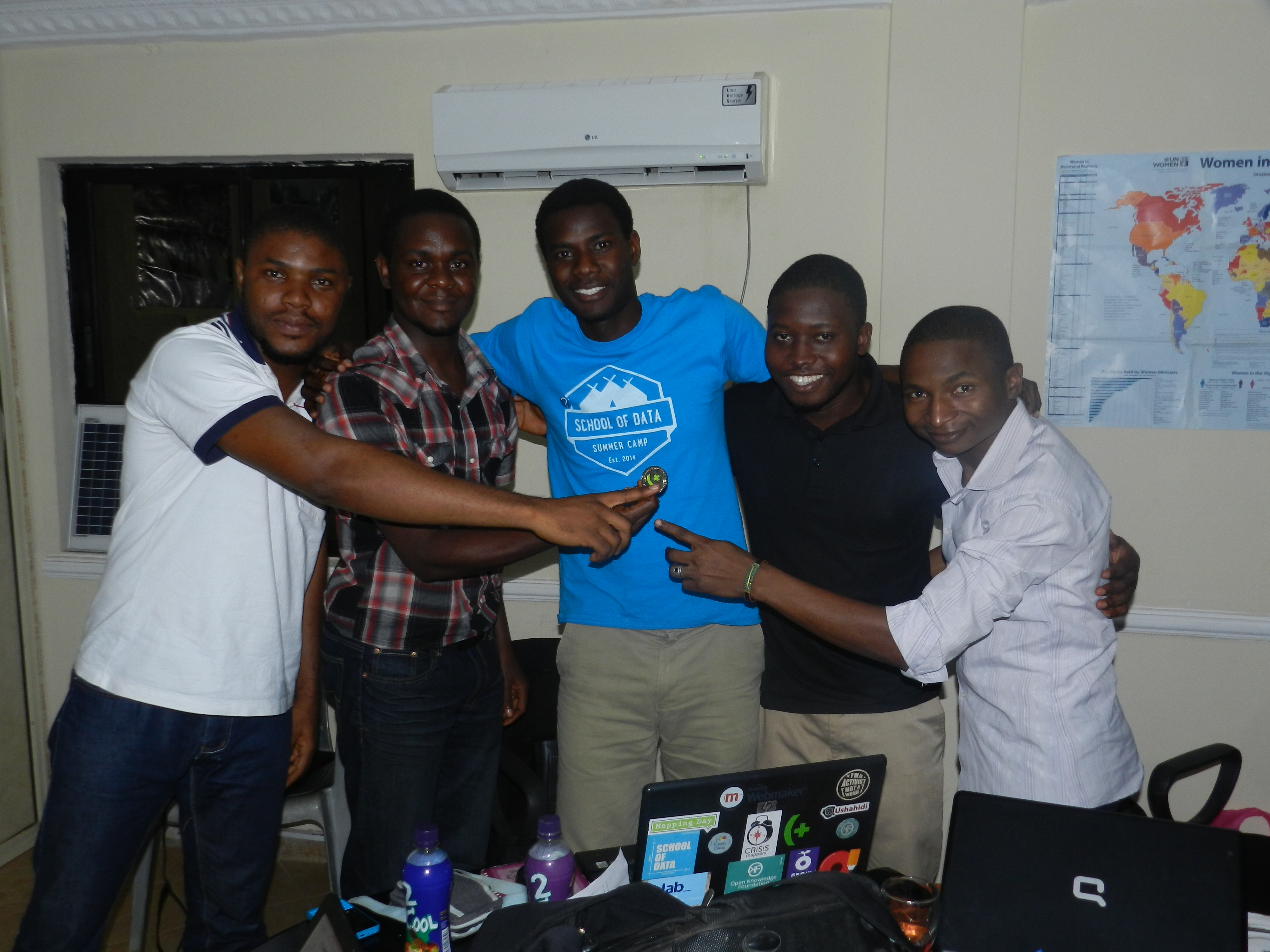
(The winning team of the Hack4Good Nigeria) From Left -Ben; Manga; SchoolofData Fellow -Oludotun Babayemi; Habib; Chief Executive, CODE - Hamzat
(The winning team of the Hack4Good Nigeria) From Left -Ben; Manga; SchoolofData Fellow -Oludotun Babayemi; Habib; Chief Executive, CODE – Hamzat
Living with coders all through the weekend, was mind blowing, and these results and outputs would not be scaled without its challenges. “Bringing our EMERGY application live as an application that cuts across several platforms such as java that allows it to work on feature phones can be time consuming and needs financial and ideology support” said Manga, leader of the first team. Perhaps, if you want to code, do endeavour to code for good!
- See more at: http://schoolofdata.org/2014/09/16/a-weekend-of-data-hacks-and-maps-in-nigeria/#sthash.PaJxPeOU.dpuf

Friday, July 22, 2011

THE LAGOS FLOOD AND BEYOND: GETTING IT RIGHT IN DISASTER PREPAREDNESS AND EMERGENCY RESPONSE


In the wake of July 10, 2011, Lagos was greeted with a torrential rainfall of about 300m that resulted into flood of about 1000mm to 1200mm. Still battling with that, the Calabar Flood struck, displacing thousands of people. All were forecasted by the Nigerian Meteorological Agency (NIMET);that became the beginning of Lagos floods and became a disaster when it claimed the lives of no fewer than 31 persons (as reported by Vanguard, July 15, 2011) including a 5year old that was drown.

Most definitely, this will not be the last of disasters we will be experiencing in Lagos, and perhaps, some other vulnerable states in Nigeria. Even as the unverified news of a 20-meter high tide tsunami heading towards the coast of Lagos, Lome and Accra, following an offshore quake in Malabo circulates round the disaster risk response world.

Consequently, We might need to ask ourselves, if we are prepared for natural disasters in Nigeria? and if we are, how fast do we respond to all these disasters, we call emergency management. With the head of the senate recently reiterating the need for emergency response managers to quickly and hastenly develop disaster response techniques - Perhaps, its time to take a cue from the Haiti Earthquake, the Negris Cyclone, the Alabama Tornadoe, the Pakistan Flood, and the recent Japan Earthquake.

Analytically, the world is changing, and we now live in a "state where a traditional framework and several experimental approaches existed in parallel — a period when the explanatory power of the old system wanes while some inchoate new system explores and codifies the methods that are strong enough to begin replacing the old ones" as Thomas Kuhn defined Paradigm Change in the Structure of Scientific Revolutions. The working tools that are now been deployed before, during and after disaster is the growing Virtual Technology Communities (VTCs) that we call "humanitarian technologists".

These new breeds are experts who are most often technical professionals with deep expertise in geographic information systems,mapping, web development and database management, social media, and/or online campaigns - they apply their skills to some of the hardest elements of disaster risk communities. They include the international Network of Crisis Mappers, Google Map Maker, Ushahidi, The Global Earth Observation - Catastrophe Assesement Network (GEO-CAN), The SBTF ( Stand by Task Force), Crisis Commons, Random Hacks of Kindness RHoK.

Quite notably, is the fact that VTCs will never replace the current institutional
frameworks of Nigerian Meteorological Agency(NIMET), National Emergency Management Agency (NEMA) and its state agencies,and other humanitarian organizations, but crisis response and other elements of the disaster risk management cycle are approaching a state resembling a shift in paradigm. It is pertinent for these organizations to start bulding capacity in this vein, and look for ways to collaborate with professionals that uses this technology, those in Nigeria and in diaspora. Because the penetration of Internet and Mobile Technology is escalating everyday in our Country, it will be a shift to a new direction to leverage on their potentials, for which these new technologies are been used.

Thursday, May 26, 2011

EMERGENCY/CRISIS MANAGEMENT AND CROWDSOURCE MAPPING IN NIGERIA


Emergency management (or disaster management) is the coordination and integration of all activities necessary to build, sustain and improve the capability for disaster prevention, mitigation, preparedness, response and recovery. It is the continuous process by which all individuals, groups and communities manage hazards in an effort to avoid or ameliorate the impact of disasters resulting from the hazards. And, effective emergency management relies on thorough integration of emergency plans at all levels of government and non-government involvement.

Nigeria has continued to witness a series of embarrassing disasters and emergency situations that are largely human-induced from post-election violence, youth militancy, communal clashes, religious conflicts, fire outbreaks, road accidents, kidnapping and robberies. The magnitudes of the carnage usually overwhelm response agencies responsible for tackling and mitigating the situations.

The National Emergency Management Agency (NEMA) as the coordinating organ for response agencies becomes the major attraction, even when its staffs on humanitarian duties survives attacks from warring parties, cases which have been seen during the Jos ethnic crisis, communal clashes between villages. It could be said that with NEMA in place in Nigeria, we have had the problem of coordination with local disaster management, during pre and post emergencies and disasters and because disasters are always localized, all the five phases of emergency management – prevention, mitigation, preparedness, response and recovery depend on local structures, which are not effective, to succeed.

Nevertheless, emergency management and coordination has shifted from grounds men to the use of technology to co-ordinate emergencies and humanitarian services. In recent years, advancements in technologies have made it possible for virtual communities such as OpenStreetMap, Ushahidi, Sahana, CrisisMappers, Virtual Disaster Viewer, Google MapMaker and INSTEDD to provide increasing support to disaster preparedness and emergency response efforts. A feat that has helped in managing crisis in Libya using the Libya Crisis Map, was used in co-ordinating humanitarian affairs in Haiti and in the Alabama Tornadoes and a list of others.

With disasters been prevalent in Africa, it is most important that we begin to look at leveraging on these technologies, thus leading to capacity building in this area, which in some months will start, no thanks to crisismappers members that are resided in Nigeria. Our Strength lies in the number of Nigerians that uses mobile technologies in communication escalating every day. We hope to create crisis camps in each state, which might comprise of disaster emergency officers, especially in states, Information Technology professionals, social entrepreneurs and volunteers.