Showing posts with label Zamfara. Show all posts

Monday, September 29, 2014

[MY POST ON @SchoolofData BLOG]: BREAKING THE KNOWLEDGE BARRIER: THE #OpenData PARTY IN NORTHERN NIGERIA

If the only news you have been watching or listening to about Northern Nigeria is of the Boko Haram violence in that region of Nigeria, then you need to know that other news exist, like the non-government organizations and media, that are interested in using the state and federal government budget data in monitoring service delivery, and making sure funds promised by government reach the community it was meant for.
This time around, the #OpenData party moved from the Nigeria Capital – Abuja to Gusau, Zamfara and was held at the Zamfara Zakat and Endowment Board Hall between Thursday, 25 and Friday, 26, 2014. With 40 participant all set for this budget data expedition, participants included the state Budget Monitoring Group (A coalition of NGOs in Zamfara) coordinated by the DFID (Development for International Development) State Accountability and Voice Initiative (SAVI),other international NGOs such as Society for Family Health (SFH), Save the Children, amongst others.
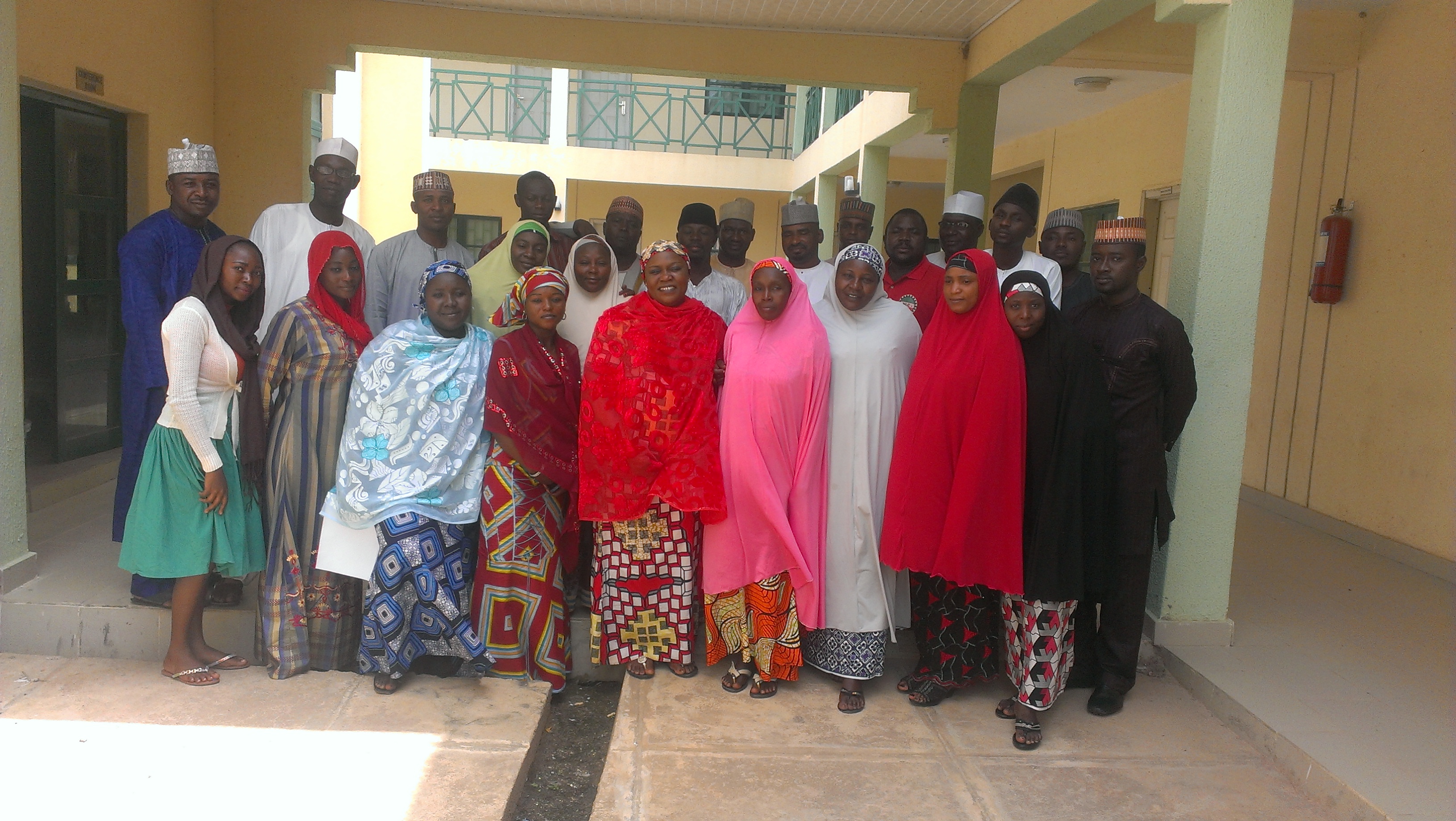
IMAG1553
Group picture of participants at the #OpenData Party in Zamfara
But how do you teach data and its use in a less-technology savvy region? We had to de-mystify teaching data to this community, by engaging in traditional visualization and scraping – which means the use of paper artworks in visualizing the data we already made available on the Education Budget Tracker. “I never believed we could visualize the education budget data of the federal government as easy as what was on the wall” exclaimed Ahmed Ibrahim of SAVI
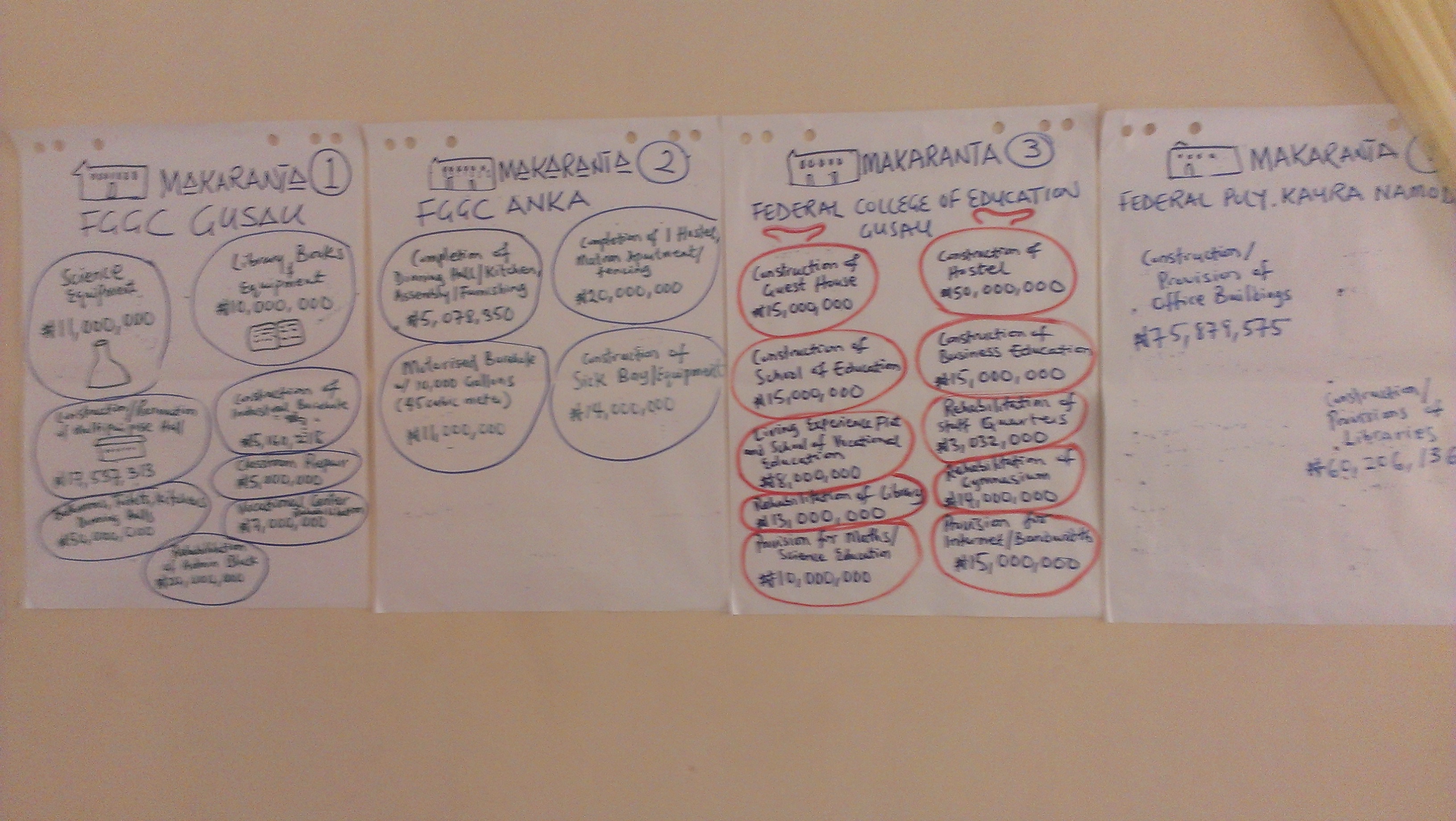
IMAG1516
Visualization of the Education Budget for Federal Schools in Zamfara
As budgets have become a holy grail especially with state government in Nigeria, of most importance to the participants on the first day, was how to find budget data, and processes involved in tracking if services were really delivered, as promised in the budget. Finding the budget data of the state has been a little bit hectic, but with much advocacy, the government has been able to release dataset on the education and health sector. So what have been the challenges of the NGOs in tracking or using this data, as they have been engaged in budget tracking for a while now?
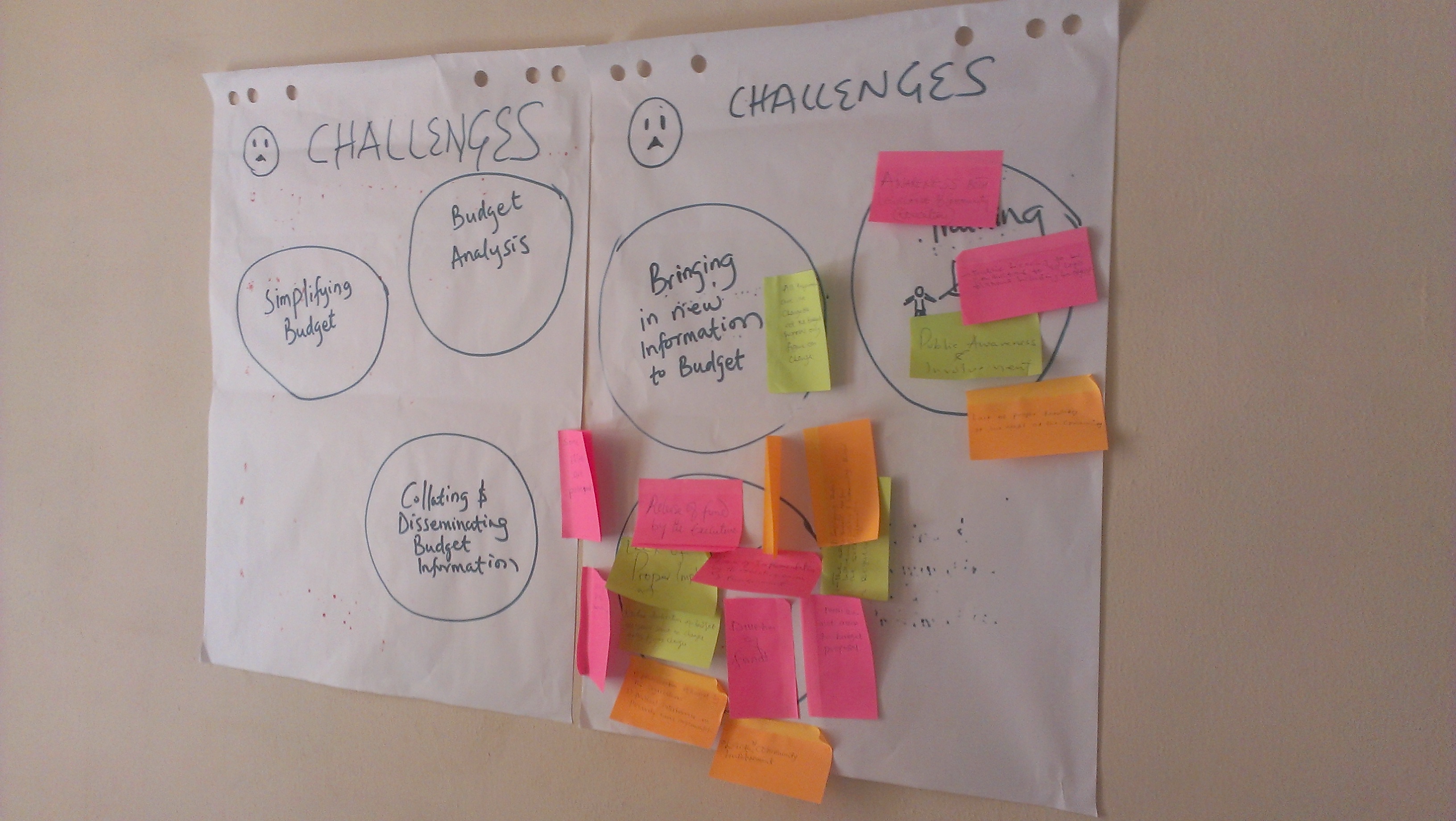
Challenges of Budget Tracking Highlighted by participants
“Well, it is important to note that getting the government to release the data took us some time and rigorous advocacy, added to the fact that we ourselves needed training on analysis, and telling stories out of the budget data” explained Joels Terks Abaver of the Christian Association of Non Indigenes. During one of the break out session, access to budget information and training on how to use this budget data became a prominent challenge in the resolution of the several groups.
The second day took participants through the data pipelines, while running an expedition on the available education and health sector budget data that was presented on the first day. Alas! We found out a big challenge on this budget data – it was not location specific! How does one track a budget data that does not answer the question of where? When involved in budget tracking, it is important to have a description data that states where exactly the funds will go. An example is Construction of Borehole water pump in Kaura Namoda LGA Primary School, or we include the budget of Kaura Namoda LGA Primary School as a subtitle in the budget document.
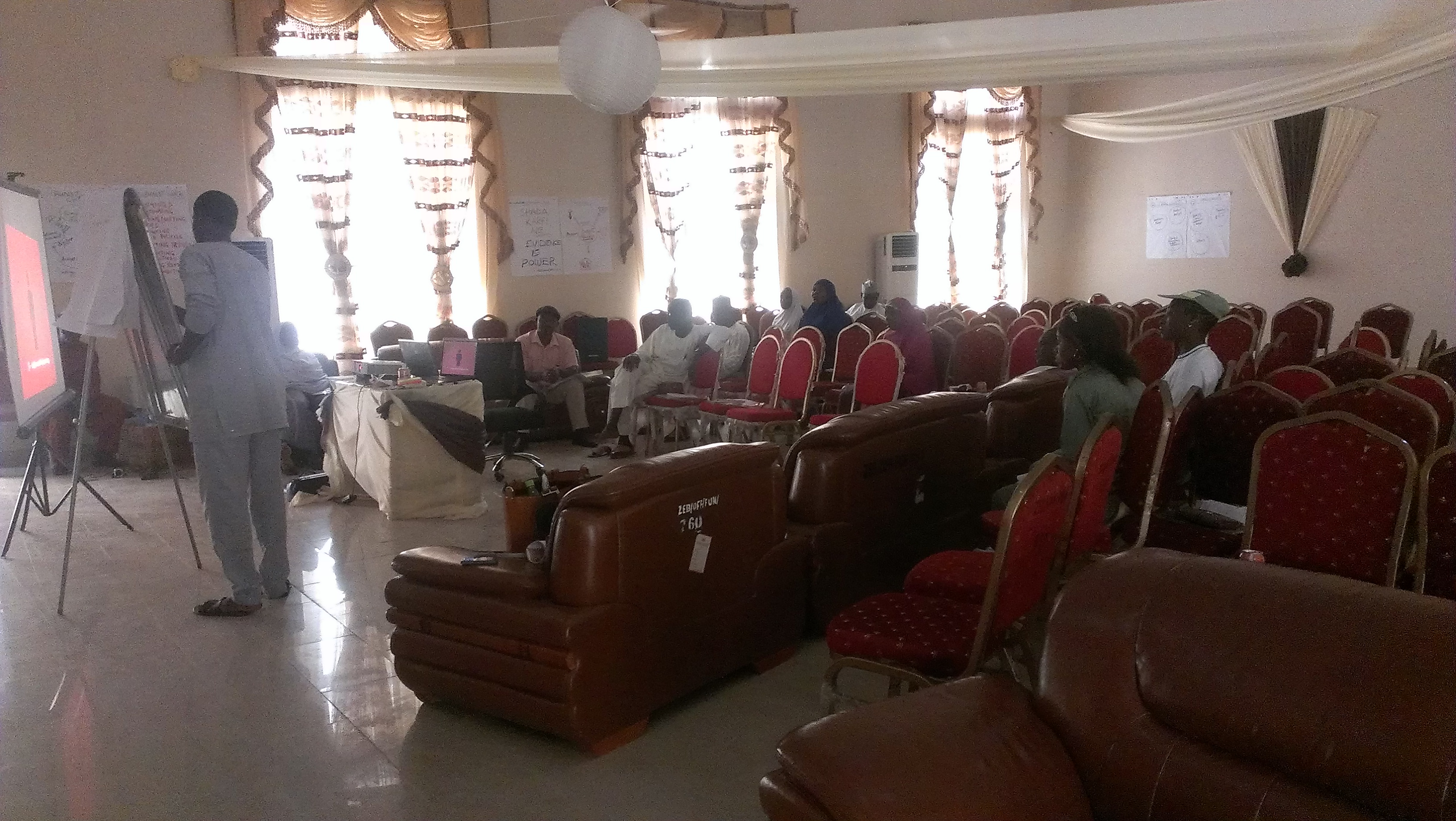
Taking participants through the data pipelines and how it relates to the Monitoring and Evaluation System
In communities like this, it is important to note that soft skills are needed to be taught – , like having 80% of the participants not knowing why excel spreadsheets are been used for budget data; like 70% of participants not knowing there is a Google spreadsheet that works like Microsoft Excel; like all participants not even knowing where to get the Nigeria Budget data and not knowing what Open Data means. Well moving through the school of data through the Open Data Party in this part of the world, as changed that notion.”It was an interesting and educative 2-day event taking us through the budget cycle and how budget data relates to tracking” Babangida Ummar, the Chairman of the Budget Working Group said.
Going forward, this group of NGO and journalist has decided to join trusted sources that will be monitoring service delivery of four education institutions in the state, using the Education Budget Tracker. It was an exciting 2-day as we now hope to have a monthly engagement with this working group, as a renewed effort in ensuring service delivery in the education sector. Wondering where the next data party will happen? We are going to the South – South of Nigeria in the month of October – Calabar to be precise, and on the last day of the month, we will be rocking Abuja!
- See more at: http://schoolofdata.org/2014/10/01/breaking-the-knowledge-barrier-the-opendata-party-in-northern-nigeria/#sthash.sbEvoBaa.dpuf

Monday, January 20, 2014

GUTSURA, THE FORGOTTEN FLOODED COMMUNITY BY THE ZAMFARA RIVER

Millions of crops and hundreds of hectares of land, as been lost to flooding in Gummi Local Government area of Zamfara State. Consequently, the #Walkt oMali team chose the LGA as its first stop. The journey from Gusau, the capital of Zamfara to Gummi is about 300km. We had to sleep at Anka, while on Monday January 20 we proceeded to Gummi. To our surprise, it took us one hour to get a car to hitchhike on!
Gummi looks more developed than Anka, we visited the plalace of the Emir, and the team was welcomed by the Gummi senior district head, Lawali Banjiye( Bunun) . We had a one hour of focus group discussion at the palace about environmental and peace building issues within the community after which, we confirmed our community of interest was Gutsura.


Located about 60km from Gummi town, Gutsura is situated by the Zamfara River, which took its source from the River Niger.  The village has no source of power and health center, but has an MTN mobile network coverage, with just one well as their source of water. “Our community has been experiencing flooding for the past 10 years” explained Alhaji Umaru Nasarawa, the village head. Gutsura has about 570 households and 3,000 residents. Alhaji Umar also explained how swift they were able to have access to relief materials during the 2013 flood. Nevertheless, he reiterated that government has not helped in relocation [construction of permanent buildings, providing water, and electricity] of Gutsura to the new site allocated to them at New Gutsura
The team with Tukur at the New Gutsura Site

The #WalktoMali team engaged the youths of the community to a participatory mapping exercise while also documenting their local knowledge – the community itself has developed building a local embankment to reduce the impact of the flood. While this might not be enough, much will be needed to help build a solid, more concrete and longer embankment. Muhammad Tukur, the community spokesperson emphasized on how the village needs an urgent attention.


We have made up our mind to start moving to New Gutsura since the government has not started erecting shelter, but our greatest challenge is getting water from the site. I have personally dug three wells at the site, but couldn’t get water from one!” lamented Tukur.


As the rains will soon be here again, this village will be left with building more resilience to prevent flooding, except the government, international aid agencies, private companies build houses and important social amenities for this ailing community, or help them build a stronger embankment to prevent the next flooding, that is always experience due to the rise in water level from the Mashayar Dantudu River.

Tuesday, October 8, 2013

HOPE FOR ARTISANAL SMALL SCALE MINERS IN ZAMFARA?

Artisanal and Small-scale Mining (ASM), is carried out by an estimated number of 15 million miners, provides an approximate 100 million people with a living, and accounts for about 15% of the worldwide primary gold production. About half of the world’s estimated 30 million ASM miners are dedicated to gold extraction.

The number of people involved in ASM in general has risen dramatically during the last years, with Nigeria contributing between 50,000 to 150,000 man power to this sector, and ASM is often referred to as a new “phenomenon” and alleged “problem”. ASM is however as old as human civilization and only recently, during the first half of the past century, the technological divide between large and small scale mining occurred. Global awareness about the importance and extension of this sector is rising and focusing on social and environmental responsibility.
Artisanal Small Scale Miners at Sunke Zamfara Nigeria

 In Zamfara, ASM is a spontaneous self-organizing social system while industrial mining is planned and centrally coordinated. Artisanal miners engage in mining to earn a living, while industrial mining is driven by corporate economic considerations. Miners focus on industrially not economic small high-grade mineral deposits in ‘open access’ condition, and employ a ‘common pool resources’ management approach. Truth be told, ASM is an important source of local income and often drives local development. Low technologic levels, at the budget of rural communities, have however had serious consequences on health, safety and environment in Zamfara. A griming example is the lead poisoning epidemic that caused the death of 400 children in seven artisanal gold mining communities in Zamfara during the hazy weather of 2010.
 
Conducting a preliminary Baseline Study of ASMs in Zamfara
In Zamfara, the contamination of compounds with high lead tailings is quite alarming, and calls for urgent attention. In countries such as Peru, Bolivia and Ecuador, they have succeeded in stopping the use of mercury, a more potent and deadly heavy metal than lead. The widespread use of mercury is a matter of global concern, while Zamfara still struggles with lead extermination, how to encourage Artisanal miners to stop the use of mercury still remains a big task. Global mercury emissions from gold ASM are currently estimated in the range of 1000 tons per year, with Nigeria contributing about 10 to 25 tons. Only half a decade ago, in 2005, estimations were still in the range of 320 tons or 17 per cent of anthropogenic mercury emissions. Under current conditions, it is reasonable to expect this trend to continue in the coming years.


Legal frameworks (or their absence) and economic interests of power groups force ASM in many countries into the informal sector. Given a certain complexity of the issues related with ASM, a common approach of the past was to ignore and marginalize artisanal miners. This made problems and especially resource conflicts, e.g. between communities and industrial mining only worse. National and even networked efforts remained isolated. Only recently, the need to engage in formalization processes in a multi-stakeholder context of Governments, Industry, Civil Society, ASM, Consumers, and Development Agencies is slowly becoming a common consensus.

On October 29, 2013, about 60 participants, at a stakeholders meeting organized by Global Rights [a human rights based non-profit] and Follow The Money [A Connected Development transparency and accountability non-profit network], sat in the conference room of the Fulbe Villa in Gusau, Zamfara, in Northern Nigeria to deliberate on how artisanal miners can leave out of poverty, sustainably without tampering with the natural ecosystem. One of the salient issues was the process of formalization of ASMs, and the capacity of the state ministry of health to carry out emergency response to lead poisoning cases that has become rampant in the communities. In Nigeria, ASM are recognized immediately they have been issued certificated to carry out such mining practices, and it is been supported by the National Minerals and Metal Policy, and the Nigeria Minerals and Mining Act, both actualized in 2007.
Cross section of participants at the Stakeholders meeting in Fulbe Villa, Gusau, Zamfara
At the meeting, it was affirmed that the Ministry of Mines and Steel Development [MMSD] has commenced with the process of formalizing artisanal miner, with about 45 registered ASM cooperatives. For the past 20 years, “the individual Gold panner is a myth” as ASMs must be organized into small work groups or larger clusters of workgroups. With lessons learnt from other part of the world, government can never be in a position to efficiently enforce compliance of thousands of individual miners. In Peru, ASM were already formed as clusters of workgroups, while in Mongolia they formed partnerships. Nevertheless, legalization alone makes environmental compliance not enforceable, government must introduce locally, workable, and adaptable technologies, which must be tested locally. In Mongolia, when the use of mercury was banned in 2008, the government introduced a viable technology solution for a mercury and cyanide free processing plant.

In the same light, the MMSD has taken a bold step in the purchase of 3 Egoli machines and 9 wet milling machines. However, one may ask if that will be enough for the growing population of ASM in Zamfara. More often than not, the response of governments is to ignore ASM, but legalization of ASM needs however to be seen as a first step that is part of a larger strategy for ASM formalization integrating social, environmental, labour, health and safety, economic, commercial, gender, organizational and technical dimensions. The implementation of most technical environmental improvements requires a balanced combination of their demonstrated feasibility, capacity building in miners as well as in support organizations and supervision agencies, and realistic enforceable requirements for which the technology provides a solution. Within a formalization process, this creates intentional artificial win-win options.

Environmental and health management of ASM needs to be seen in a wider context of responsible mining. Lead poisoning and contamination is highly prevalent in Zamfara, while acute mercury poisoning is very rare, opposite to chronic poisoning which accumulates often over years. For miners, the toxic effects of mercury are not as obvious as for scientists. Concerns of workplace safety, the risks of accidents, and the often lacking health services in mining communities in combination with generally harsh and unhealthy living conditions in remote places are perceived a much higher priority. For the umpteenth time, the stakeholders have called on the state ministry of health to rise up to its responsibilities. “Many times we have called on the state ministry of health to join in complementing the work of humanitarian organizations working in treating lead poisoned children, but no response” said Ahmad Ashim These concerns have to be taken serious, as they directly affect the quality of life of the miners and their families, and because without addressing them, projects not only lose credibility in the eyes of the miners but fail to contribute to responsible ASM and sustainable development.

Responsible ASM cannot be done in an unorganized way. ASM can only be organized if ASM organizations are in place. ASM organizations need to be empowered to be able to organize the extractive activity. ASM is a (self-) employment generating activity in remote areas, whereby the location is determined by the mineral deposit. Miners and their families create their communities and livelihoods and aspire development, still in the same way as miners did 150 years ago by creating the gold rush settlement of Sacramento and converting it into the Capital of the US State of California. In the already existing and regulated societies of today, a broader formalization approach must support and accompany the miners in this process. An ASM formalization process therefore must not be limited to the pure legal aspects, but incorporate community development and broad capacity building. This creates the capacity to comply with social and environmental requirements and makes requirements enforceable. ASM communities require equal rights and a similar level of attendance by the public sector as other communities; most “problems of ASM” are home-made and are created by denying miners these rights, and marginalizing them.