Friday, October 24, 2014

Monday, September 29, 2014
[MY POST ON @SchoolofData BLOG]: BREAKING THE KNOWLEDGE BARRIER: THE #OpenData PARTY IN NORTHERN NIGERIA
If the only news you have been watching or listening to about Northern Nigeria is of the Boko Haram violence in that region of Nigeria, then you need to know that other news exist, like the non-government organizations and media, that are interested in using the state and federal government budget data in monitoring service delivery, and making sure funds promised by government reach the community it was meant for.
This time around, the #OpenData party moved from the Nigeria Capital – Abuja to Gusau, Zamfara and was held at the Zamfara Zakat and Endowment Board Hall between Thursday, 25 and Friday, 26, 2014. With 40 participant all set for this budget data expedition, participants included the state Budget Monitoring Group (A coalition of NGOs in Zamfara) coordinated by the DFID (Development for International Development) State Accountability and Voice Initiative (SAVI),other international NGOs such as Society for Family Health (SFH), Save the Children, amongst others.
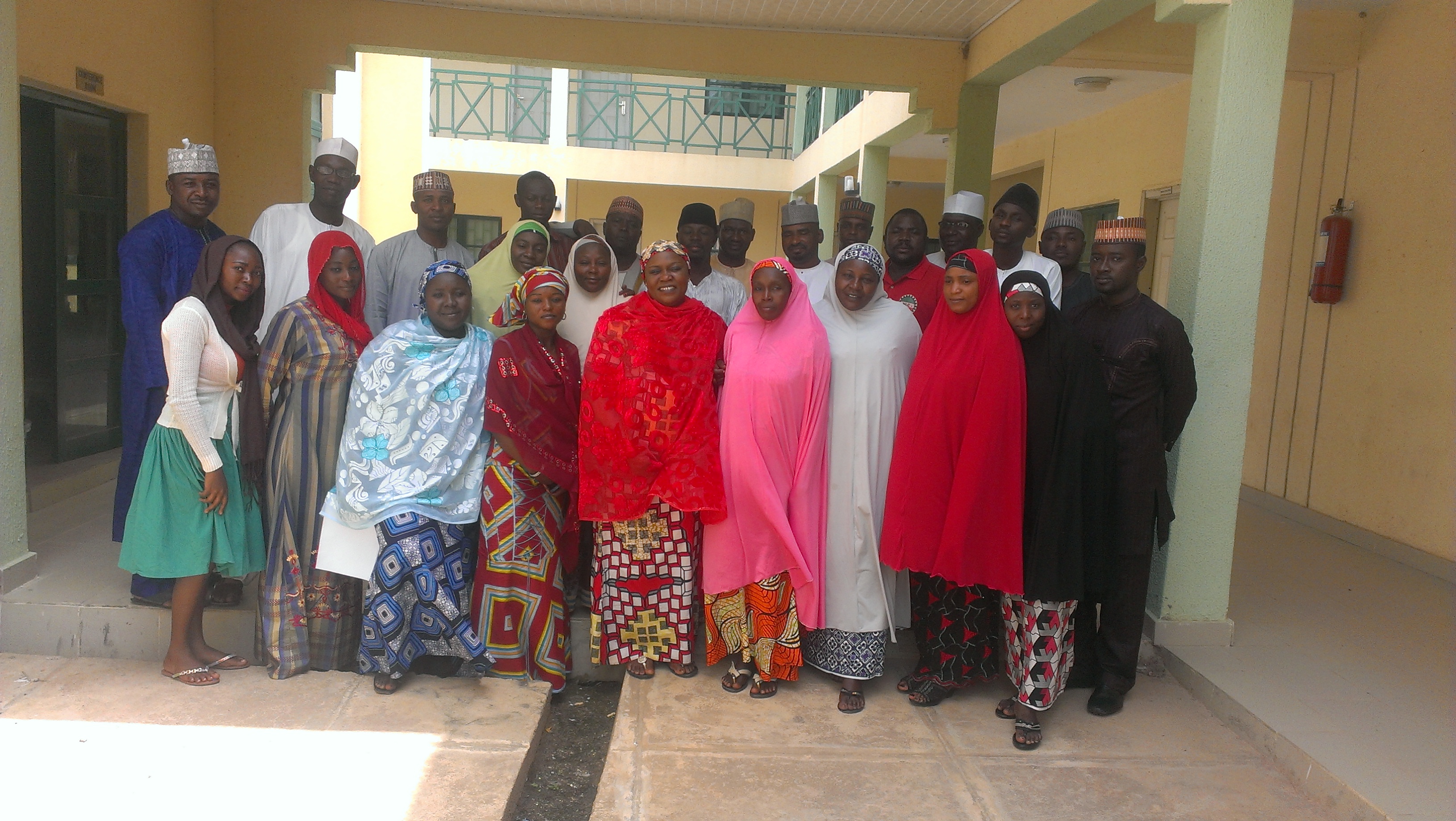
Group picture of participants at the #OpenData Party in Zamfara
But how do you teach data and its use in a less-technology savvy region? We had to de-mystify teaching data to this community, by engaging in traditional visualization and scraping – which means the use of paper artworks in visualizing the data we already made available on the Education Budget Tracker. “I never believed we could visualize the education budget data of the federal government as easy as what was on the wall” exclaimed Ahmed Ibrahim of SAVI
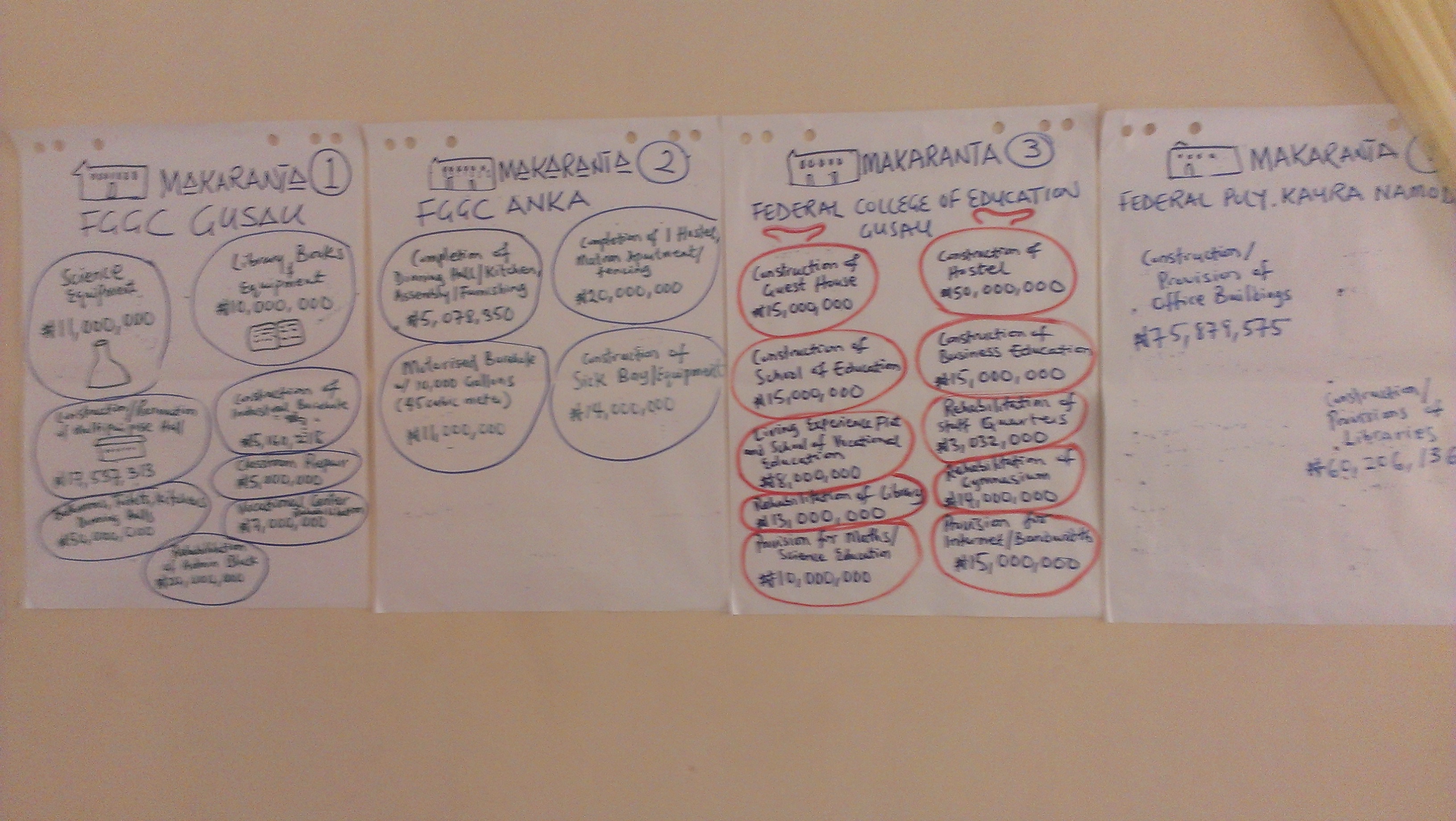
Visualization of the Education Budget for Federal Schools in Zamfara
As budgets have become a holy grail especially with state government in Nigeria, of most importance to the participants on the first day, was how to find budget data, and processes involved in tracking if services were really delivered, as promised in the budget. Finding the budget data of the state has been a little bit hectic, but with much advocacy, the government has been able to release dataset on the education and health sector. So what have been the challenges of the NGOs in tracking or using this data, as they have been engaged in budget tracking for a while now?
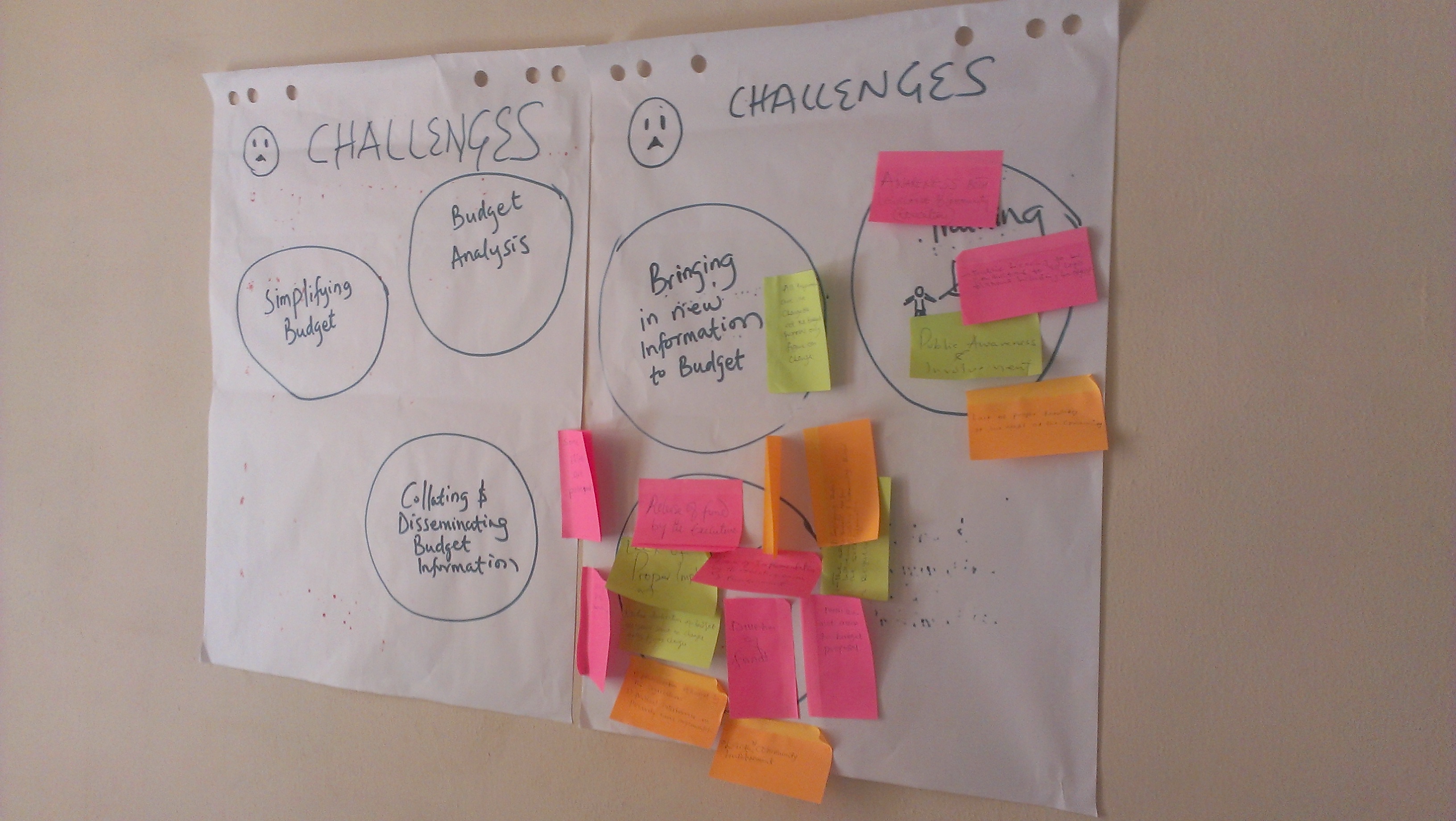
Challenges of Budget Tracking Highlighted by participants
“Well, it is important to note that getting the government to release the data took us some time and rigorous advocacy, added to the fact that we ourselves needed training on analysis, and telling stories out of the budget data” explained Joels Terks Abaver of the Christian Association of Non Indigenes. During one of the break out session, access to budget information and training on how to use this budget data became a prominent challenge in the resolution of the several groups.
The second day took participants through the data pipelines, while running an expedition on the available education and health sector budget data that was presented on the first day. Alas! We found out a big challenge on this budget data – it was not location specific! How does one track a budget data that does not answer the question of where? When involved in budget tracking, it is important to have a description data that states where exactly the funds will go. An example is Construction of Borehole water pump in Kaura Namoda LGA Primary School, or we include the budget of Kaura Namoda LGA Primary School as a subtitle in the budget document.
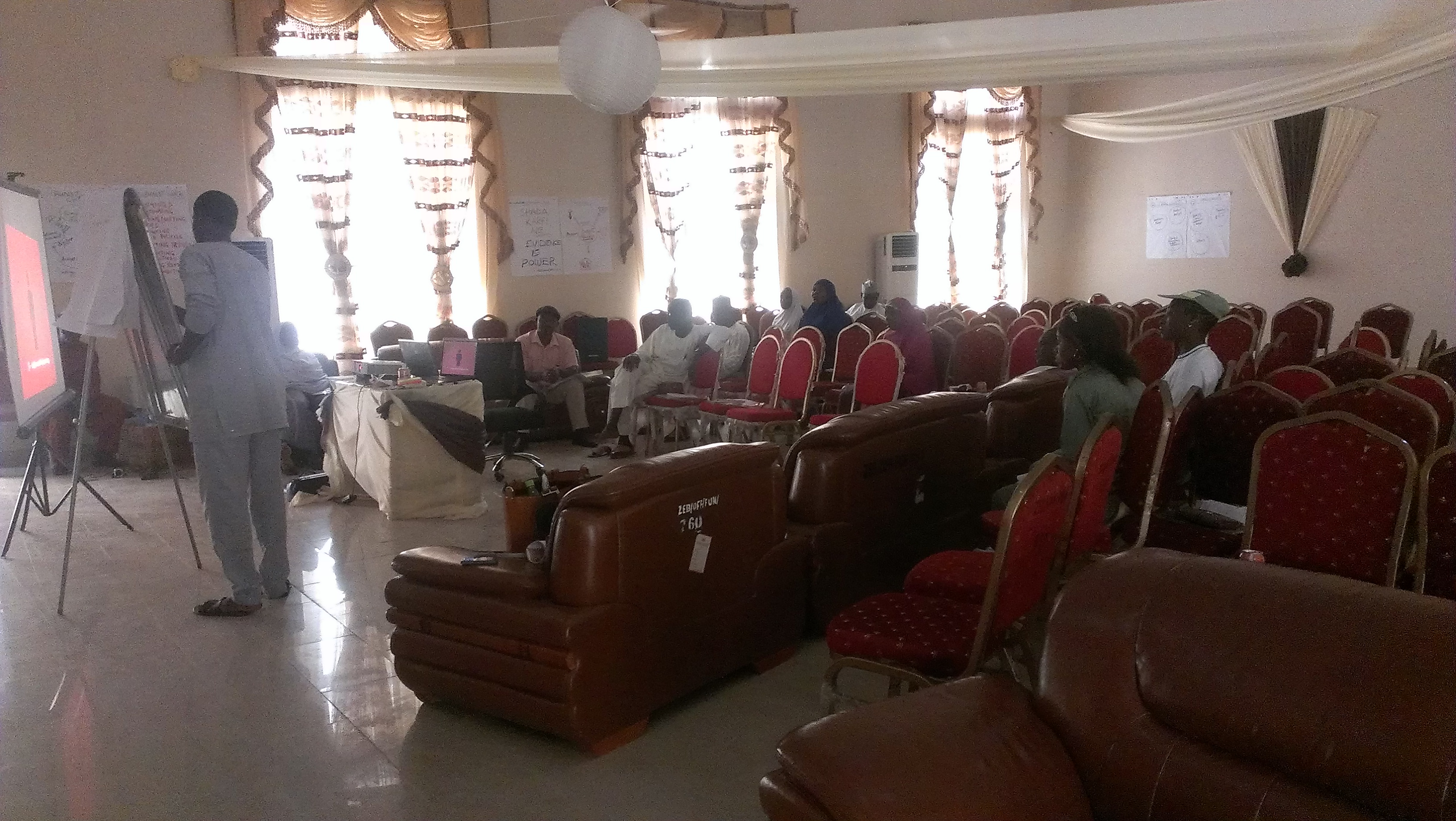
Taking participants through the data pipelines and how it relates to the Monitoring and Evaluation System
In communities like this, it is important to note that soft skills are needed to be taught – , like having 80% of the participants not knowing why excel spreadsheets are been used for budget data; like 70% of participants not knowing there is a Google spreadsheet that works like Microsoft Excel; like all participants not even knowing where to get the Nigeria Budget data and not knowing what Open Data means. Well moving through the school of data through the Open Data Party in this part of the world, as changed that notion.”It was an interesting and educative 2-day event taking us through the budget cycle and how budget data relates to tracking” Babangida Ummar, the Chairman of the Budget Working Group said.
Going forward, this group of NGO and journalist has decided to join trusted sources that will be monitoring service delivery of four education institutions in the state, using the Education Budget Tracker. It was an exciting 2-day as we now hope to have a monthly engagement with this working group, as a renewed effort in ensuring service delivery in the education sector. Wondering where the next data party will happen? We are going to the South – South of Nigeria in the month of October – Calabar to be precise, and on the last day of the month, we will be rocking Abuja!
- See more at: http://schoolofdata.org/2014/10/01/breaking-the-knowledge-barrier-the-opendata-party-in-northern-nigeria/#sthash.sbEvoBaa.dpuf
Friday, August 29, 2014
[MY POST ON @SchoolofData BLOG]: A WEEKEND OF DATA, HACKS AND MAPS IN NIGERIA
It was another weekend of hacking for good all around the world, and Abuja, Nigeria was not left out of the weekend of good, as 30 participants gathered at the Indigo Trust funded space of Connected Development [CODE] on 12 – 14 September, scraping datasets, brainstorming creating technology for good, and not leaving one thing out – talking soccer (because it was a weekend, and Nigeria “techies” love soccer especially the English premiership).
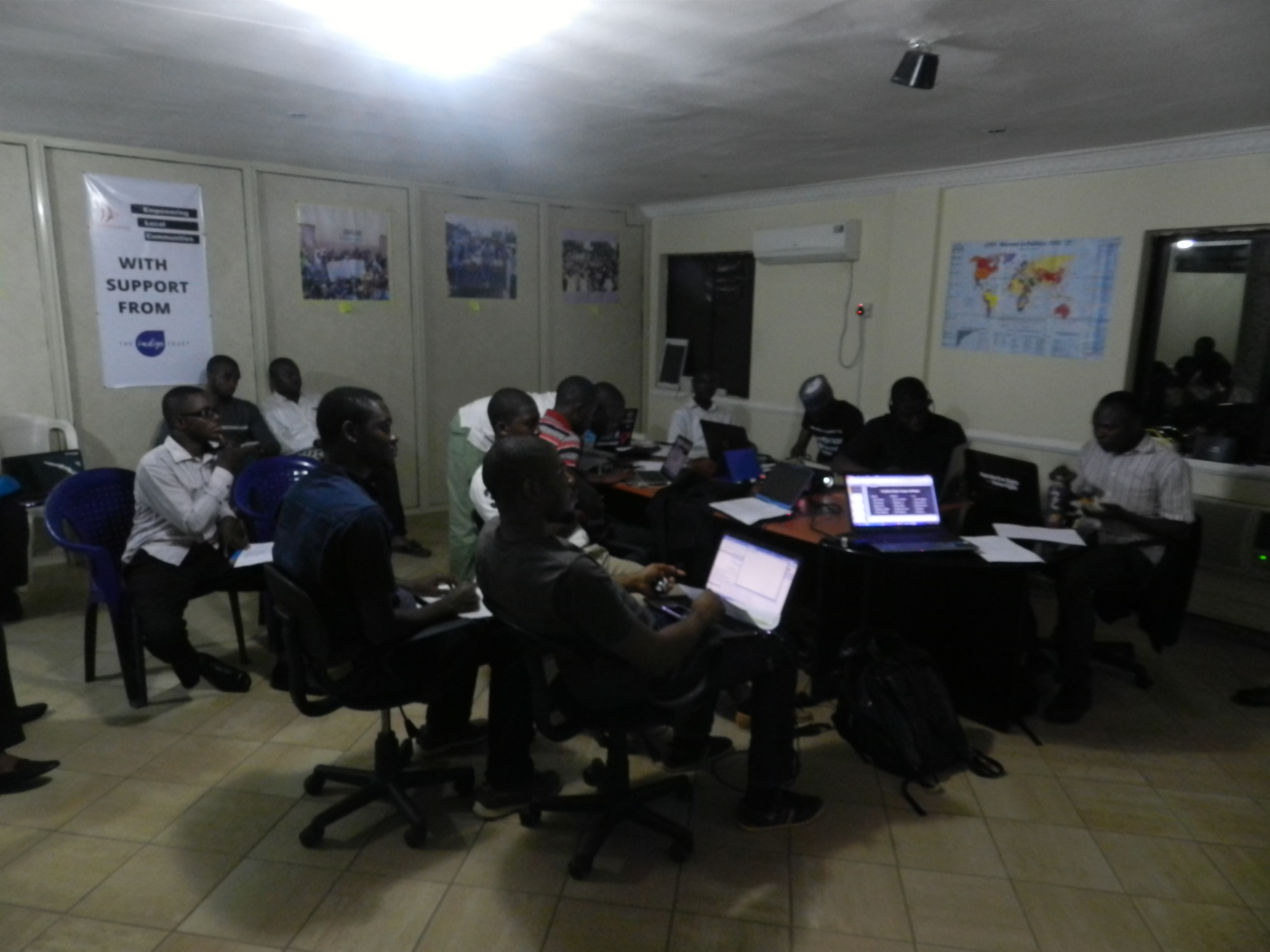
Participants at the Hack4Good 2014 in Nigeria
Leading the team, was Dimgba Kalu (Software Architect with Integrated Business Network and founder TechNigeria), who kick started the 3 day event that was built around 12 coders with other 18 participants that worked on the Climate Change adaptation stream of this year #Hack4Good. So what data did we explore and what was hacked over the weekend in Nigeria? Three streams were worked :
- Creating a satellite imagery tagging/tasking system that can help the National Space Research Development Agency deploy micromappers to tag satellite imageries from the NigeriaSat1 and NigeriaSat2
- Creating an i-reporting system that allows citizen reporting during disasters to Nigeria Emergency Management Agency
- Creating an application that allows citizens know the next water point and its quality within their community and using the newly released dataset from the Nigeria Millennium Development Goal Information System on water points in the country.
Looking at the three systems that was proposed to be developed by the 12 coders, one thing stands out, that in Nigeria application developers still find it difficult to produce apps that can engage citizens – a particular reason being that Nigerians communicate easily through the radio, followed by SMS as it was confirmed while I did a survey during the data exploration session.
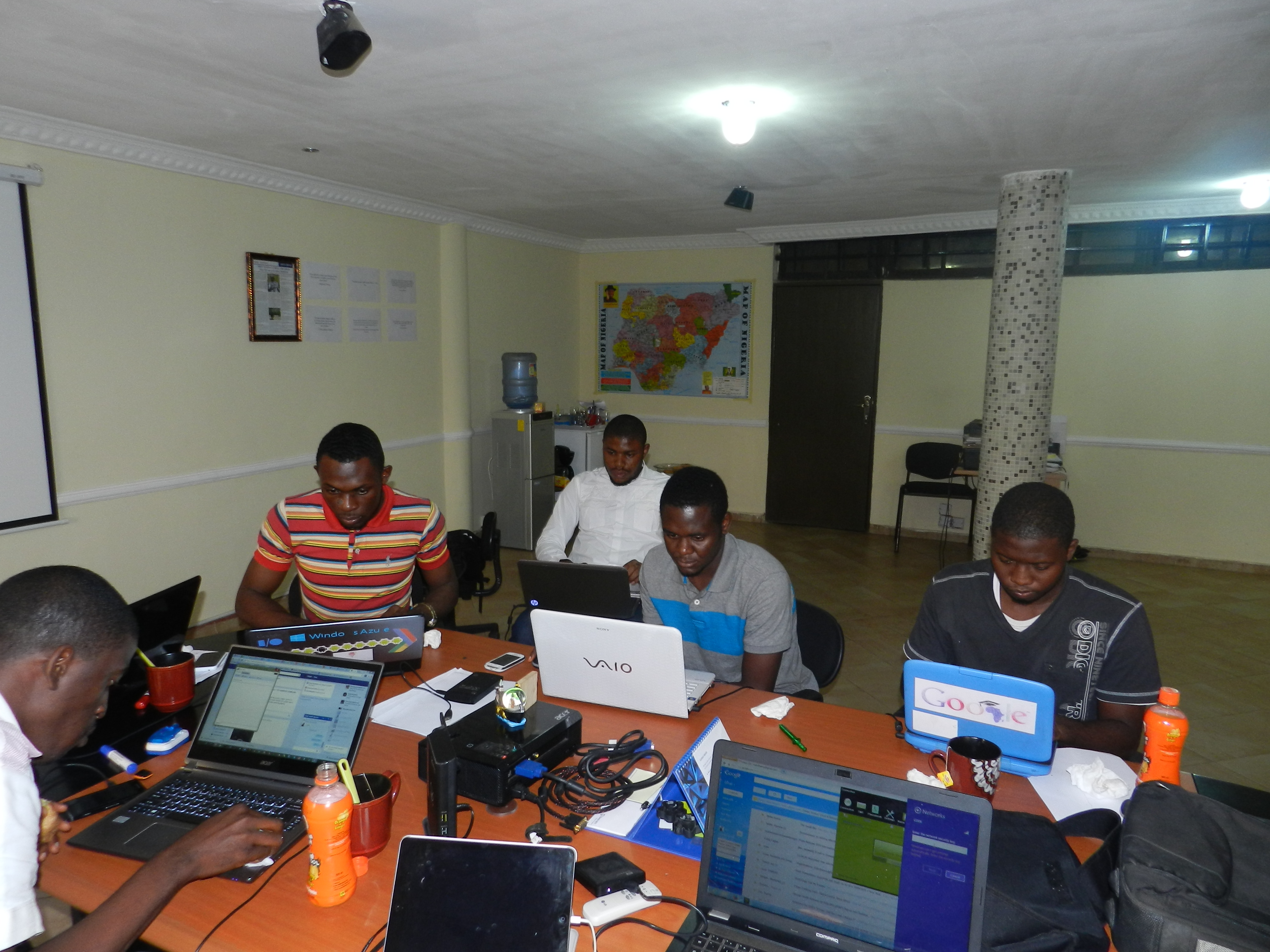
Coders Hackspace
Going forward, all participants agreed that incorporating the above medium (Radio and SMS) and making games out of these application could arouse the interest of users in Nigeria. “It doesn’t mean that Nigerian users are not interested in mobile apps, what we as developers need is to make our apps more interesting” confirmed Jeremiah Ageni, a participant.
The three days event started with the cleaning of the water points data, while going through the data pipelines, allowing the participants to understand how these pipelines relates to mapping and hacking. While the 12 hackers were drawn into groups, the second day saw thorough hacking – into datasets and maps! Some hours into the second day, it became clear that the first task wouldn’t be achievable; so much energy should be channelled towards the second and third task.
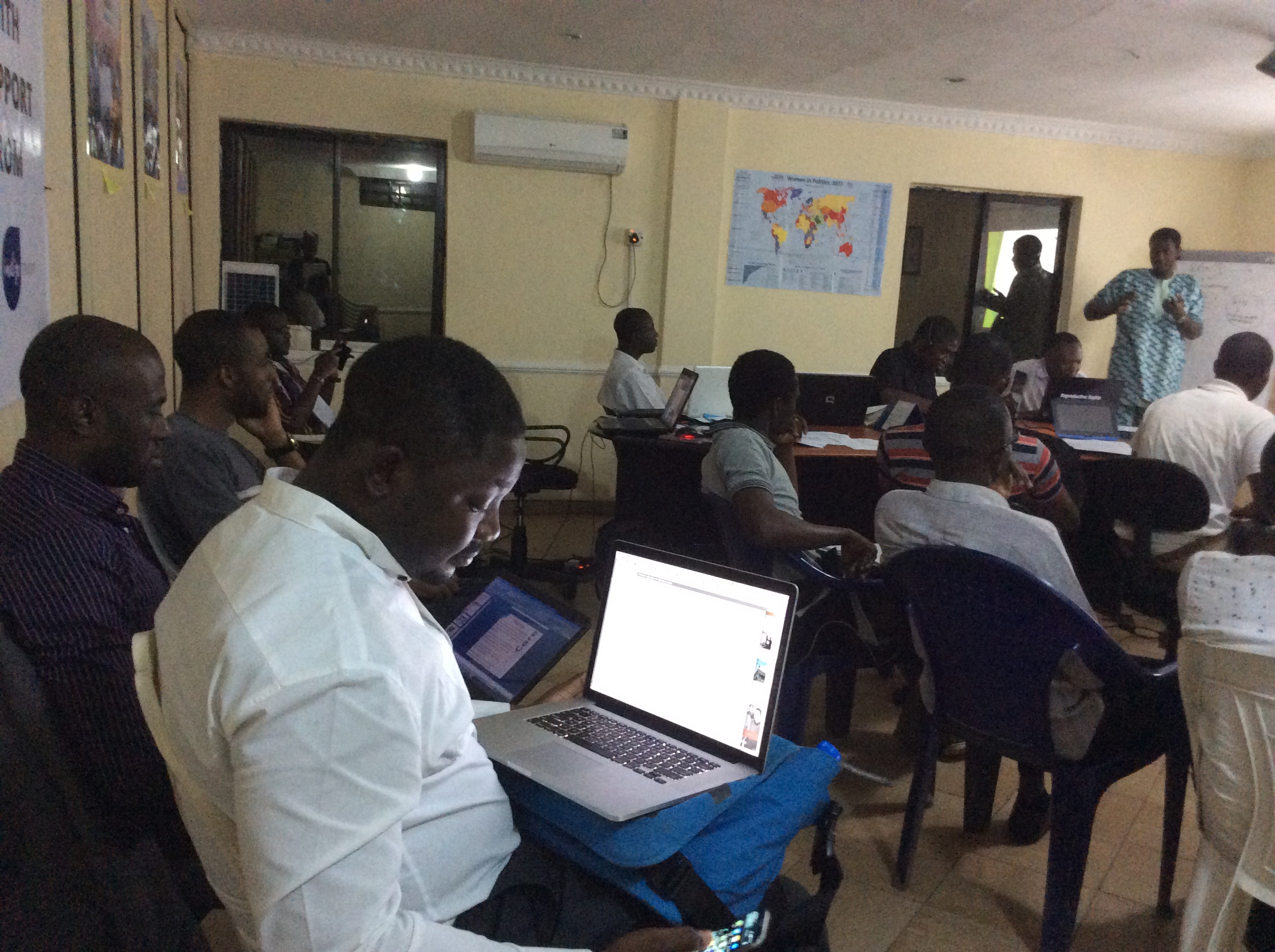
SchoolofData Fellow – Oludotun Babayemi taking on the Data Exploration session
Hacking could be fun at times, when some other side attractions and talks come up – Manchester United winning big (there was a coder, that was checking every minutes and announcing scores) , old laptops breaking (seems coders in Abuja have old ones), coffee and tea running out (seems we ran out of coffee, like it was a sprint), failing operating systems (interestingly, no coders in the house had a Mac operating system), fear of power outage (all thanks to the power authority – we had 70 hours of uninterrupted power supply) , and no encouragement from the opposite sex (there was only two ladies that strolled into the hack space).
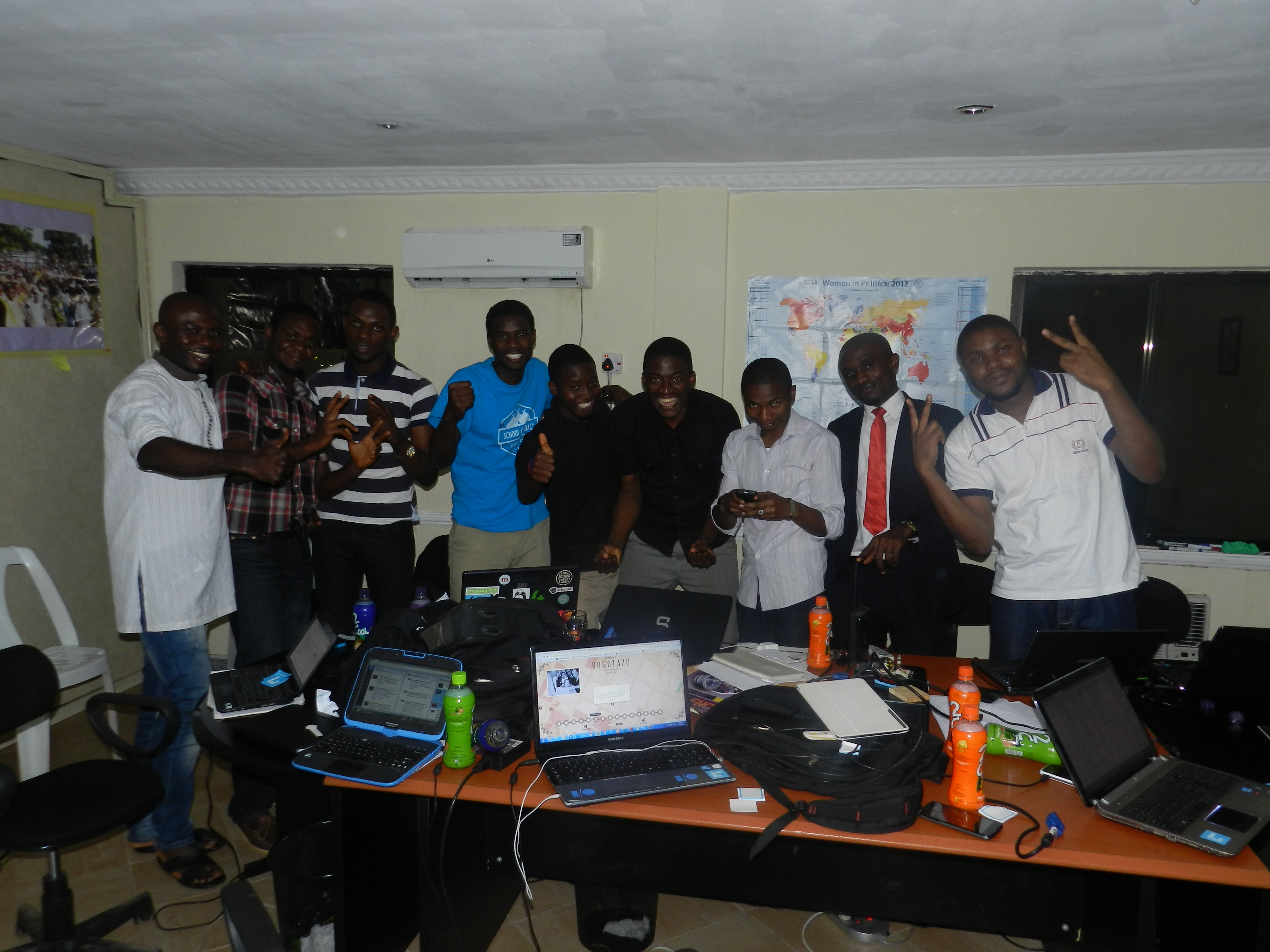
Bring on the energy to the hackspace
As the weekend drew to a close, coders were finalizing and preparing to show their great works. A demo and prototype of streams 2 and 3 were produced. The first team (working on stream 2), that won the hackathon developed EMERGY, an application that allows citizens to send geo-referenced reports disasters such as floods, oil spills, deforestation to the National Emergency Management Agency of Nigeria, and also create a situation awareness on disaster tagged/prone communities, while the second team, working on stream 3, developed KNOW YOUR WATER POINT an application that gives a geo-referenced position of water points in the country. It allows communities; emergency managers and international aid organizations know the next community where there is a water source, the type, and the condition of the water source.
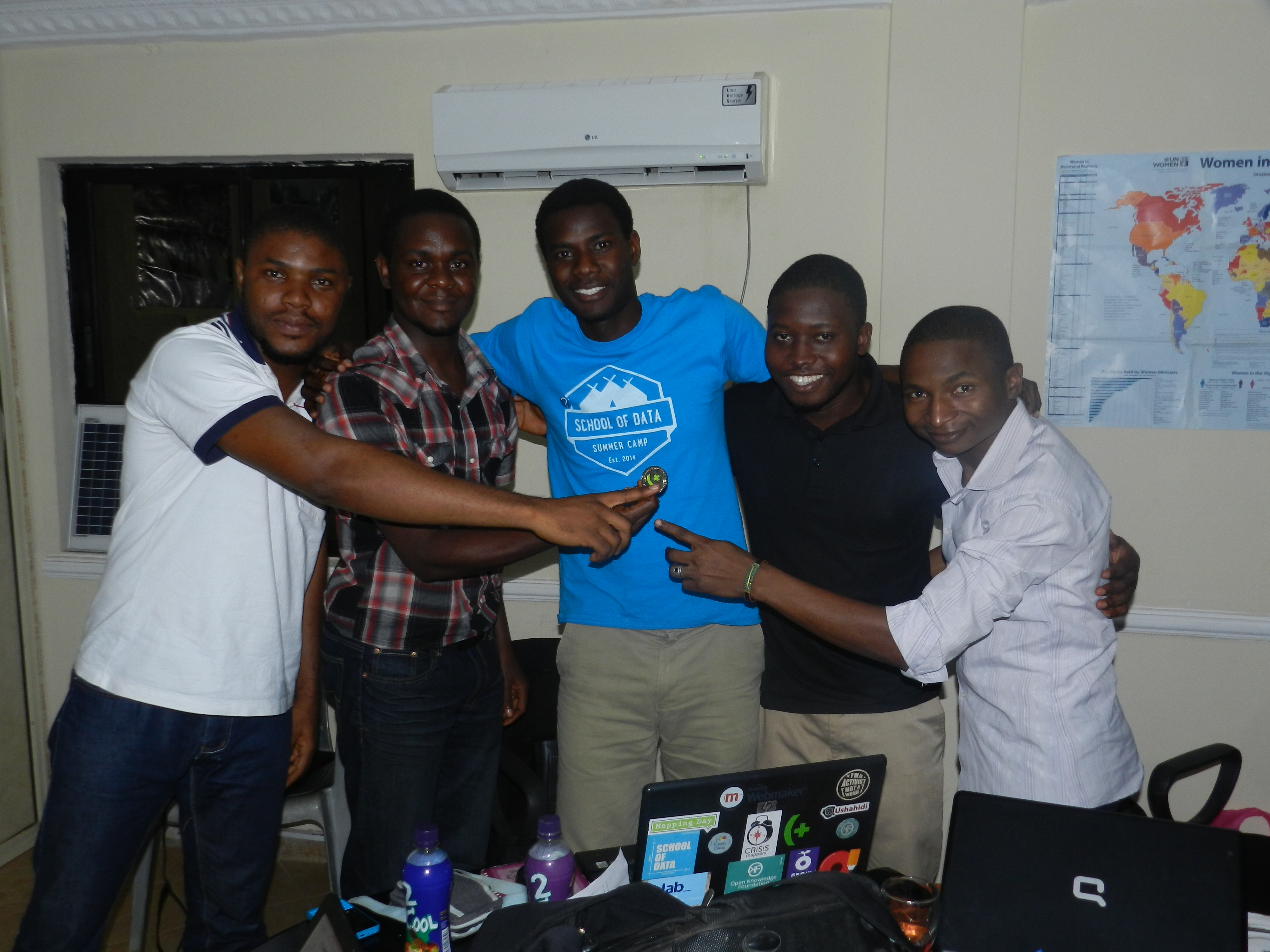
(The winning team of the Hack4Good Nigeria) From Left -Ben; Manga; SchoolofData Fellow -Oludotun Babayemi; Habib; Chief Executive, CODE – Hamzat
Living with coders all through the weekend, was mind blowing, and these results and outputs would not be scaled without its challenges. “Bringing our EMERGY application live as an application that cuts across several platforms such as java that allows it to work on feature phones can be time consuming and needs financial and ideology support” said Manga, leader of the first team. Perhaps, if you want to code, do endeavour to code for good!
- See more at: http://schoolofdata.org/2014/09/16/a-weekend-of-data-hacks-and-maps-in-nigeria/#sthash.PaJxPeOU.dpuf
Wednesday, April 9, 2014
[FOR THE PRESS] 2014 CELEBRATES THE BIGGEST EARTH HOUR CELEBRATION IN NIGERIA AND IN HISTORY
The entire world witnessed the Earth Hour
phenomenon sweep across the planet in its eighth year, as WWF’s Earth Hour 2014
broke all records of mass participation mobilizing hundreds of millions of
people to become everyday Super Heroes for the planet.
Earth Hour
proved the movement is now stronger than ever, with the event observed in over
162 countries including Nigeria and territories and over 7000 cities and towns,
creating magical lights off moments in every continent of the world. The
symbolic hour has grown into the world’s largest grassroots movement for the
environment, with beyond the hour activities and initiatives happening
throughout the year.
In Nigeria, Earth Hour organised by
Connected Development [CODE] was observed in 5 cities – Abuja at the Transcorp
Hilton; Lagos at the “Earth Hour Garden” opposite the Lagos State House of
Assembly; Taraba at the Kwararafa University in Wukari; Portharcourt at the
LeMeridien Ogeyi Place and in Benin City at the Youth House.
“It’s always extraordinary to see cities
and landmarks involved in the ‘lights off’ event, but the most exciting thing
about Earth Hour this year is seeing the amount of projects and campaigns that
are taking action beyond the hour. From crowdfunding to campaigns that are
creating environmental awareness across the West Africa region, Earth Hour is
harnessing the power of the crowd far beyond the hour,” said Oludotun Babayemi,
Country Director for Earth Hour in Nigeria.
Last year alone saw thousands of Nigerians
petitioned the president to pass the climate change bill into law to create a
climate change commission to superintend over climate change activities in
Nigeria. In 2014, the bill has been reintroduced and passed to the Senate for
harmonisation. Likewise, the Walk to Mali campaign has started inspiring
different communities across the West Africa region with the Kwararafa
University pledging a 20km reserved forest for the flora and fauna.
WWF-Uganda began the fight against the
6,000 hectares of deforestation that occurs in the country every month by
creating the first “Earth Hour Forest.” In 2012, Russians also petitioned to
get legislative change protecting the country’s seas from oil pollution and now
are striving to protect an area of forest twice the size of France.
These Earth Hour success stories illustrate
the movement has become a global collaboration to show what can be achieved for
the planet.
In
Nigeria, the Earth Hour celebration 2014 began its journey in Wukari, Taraba
where community events were held all over the community and at Kwararafa
University. Moving across to Wukari town where hundreds of community members
joined the team and held a community sensitisation and advocacy on
environmental sustainability hosted by the Taraba state coordinator, Anthony
Agbor. The event within the community was grazed by the Boys Brigade Base Band
and the Skaters Club of Wukari
The hour of inspiration then went back to
its humble beginnings, as Earth Hour once again hit Abuja bringing to light the
plight of one of the memorable hotels in the country with an environmental
friendly atmosphere – The Transcorp Hilton. The Light out event anchored by Big
Mo of Wazobia FM in Abuja, kicked off with the greetings to Nigeria cities
taking part in Earth Hour, delivered by the FCT coordinator for Earth Hour,
Oladotun Fadeyiye, while TED style keynote speech was given by Baaki John of
the Women Environmental Programme (WEP) on environmental sustainability and
women.
To drive action and support, a new
exhibition waiting to be premiered as a movie “Walk to Mali” was screened
during the hour, and the campaign also engaged people around the world to use
their power and add their voice to protect vulnerable communities. "To witness
Earth Hour in Abuja for the third year in a row, the event makes a powerful
impression on me," said Hamzat Lawal, the Chief Executive of CODE.
"To see people united in a single purpose of making our lifestyles less
impactful on the planet inspires me immensely.”
Continuing to the second home of Earth
Hour, Lagos celebrated the event by empowering young school children with the
message that people are the true everyday Super Heroes for the planet. Using
none other than Spider-Man to join the global flagship event, the young stars
from the Vicsum Private School were educated on the value of efficient energy
use. “How to Take Action” speeches were delivered by Olumide Idowu; Halima Baba
- Lagos State coordinator for Earth Hour
and Babatunde Shodiyan from the department of Conservation and Ecology of the
Lagos state ministry of Environment.
“We hope the power of Spider-Man joining in
the largest movement for the planet – Earth Hour will inspire this future
generation in becoming super heroes for their various communities on
environmental sustainability” Halima Baba said.
Right now, Earth Hour is moving across the
globe, following the setting sun, sending billions of people around the world a
message that each of us has the power to make a difference. Each of us can be a
Super Hero for the planet," Reiterated Baba said.
In Portharcourt, the lights off event then
went to the Le Meridien Ogeyi Place at GRA. Hosted by Gift Godden, the city
coordinator for the event, Earth Hour drew attention to the “Black Gold,” and
the need to reduce air pollution and Oil Spills. The participants were
encouraged to collaborate on ideas in order to inspire change towards healthier
air and communities.
“It is pertinent to include every
stakeholder in the build up to this popular environmental movement, it will
help us in achieving our advocacy campaigns towards an oil spill free
environment” said Okoduwa Sylvester of the Ofure Center for Peace and
Development.
The management of the Le Meridien Ogeyi
place was quite excited to be part of this movement again, having won a
sustainability award for taking part during Earth Hour in 2013. “This movement
will forever live in our memory, as it inspires institutions like ours to join
in and do more to save our planet earth. Next year again, we will be part of
this movement” said Henry Orie, the Food and Beverage Manager at Le Meridien.
In tandem with the crowd’s enthusiasm at
events across the world has been Earth Hour’s massive digital presence,
including the recently launched Earth Hour Blue to drive digital engagement
beyond the hour. The revolutionary platform for the planet allows anyone in any
country to use their voice or their dollar to take action and support projects
of their choice across the globe, and further encourages participants to use
their favourite social platforms to engage in their favourite crowdfunding and
crowdsourcing projects.
As a newcomer to the crowdfunding scene,
Earth Hour Blue has launched with WWF projects from Australia, Indonesia,
Singapore, China, Nepal, India, Russia, Uganda, South Africa, Madagascar,
Canada and Columbia which are now all live on the crowdfunding platform powered
by Crowdonomic.
Thursday, March 27, 2014
THE OPEN DATA DAY IN ABUJA: LIBERATING SERVICE DELIVERY IN THE EDUCATION SECTOR IN NIGERIA
As building capacity of government officials, CSOs and
journalist remains important in the data liberation evangelism, the Follow The Money team focused more on their data
expedition class on Open Data Day held at CODE with 28 participants. They
include government officials from Nigeria Extractive Industries Transparency Initiative
[NEITI], National Space Research and Development Agency [NASRDA], and the FCT Mass
Education Board, participants from the private sector, the media and CSOs. With
Oludotun Babayemi, a data enthusiast taking the participant through basics of
data design, data cleaning and publishing data, participants were thrilled having
insights on how to use data to tell stories “I have been bundle with so much
information today, and I appreciate this session, I now know where to get data
from and how to use spreadsheet for collaboration” explained an excited
Chinyere Opia from HOT FM
Demonstrating
the practical session at the Education Hackathon was quite strategic to use in
complimenting the practical sessions that went into training participants on
sorting, filtering and cleaning data. The Hackathon allowed participants to
filter and sort Nigeria data on Education within datasets downloaded from the
World Bank project sites, and also update mapping of funds from the budget
office on capital expenditures meant for federal education institutions in
Nigeria. [LOOK] how one of the participant
described #ODDAbuja
In
Nigeria, billions of Naira has been spent [through government spending and
international aid] on infrastructures on education that, often wouldn't reach
the community [Please read achieving the MDG goals in Nigeria] that it was
meant for. "Infact we have many challenges, One I will like to say is
government providing books and infrastructures that will make the children to
learn, and also levies on children which at times they might not be able to
afford" says Blessing Hassana [Watch the video], Principal of a secondary school in Nasarawa state
[that's a state just 20km away from the capital city, Abuja], what will happen
in other states? Perhaps, this says much about why there are still about 10
million out of school children in Nigeria.
With
the Education Budget Tracker still being curated for
government spending and international aid, the strategy is to focus on how many
education projects are operational in these communities. This Education Budget
Tracker which allows for education point mapping has huge potential as an
effective monitoring and management tool for planning and decision making. It
can really help government and funding agencies to know where to focus more on.
Some places might need infrastructure, while some its maintenance and others
might be training.
In
this way, the Ministry of Education and other donor agencies will be able to
monitor the impact of its large investments in the education sector. It will
also allow transparent tariff settings that reward good performance and
highlight inefficiencies. Moreover, it is interesting to know that this tool
allows trusted local people to provide information about the education service
delivery in their communities using their mobile phones. “Going forward for us,
the Follow the Money team is seeking partnership with interested entities to
pilot the usage of this tool in one of the states with poor education
performance index in northern Nigeria” says Hamzat Lawal while demonstrating
how we intend to use the tool to participants.
The
Open Data Day evening session started with a brief introduction of the Digital Humanitarian Network and how its members have
been using technologies before, during and after emergencies. How CODE intends to engage organizations and
communities interested in emergency response across the West African region
using technology was highlighted and some government participants were quite
interested and keen in how CODE will integrate crisis mapping into their
situation awareness room. “It is quite interesting to know that CODE is leading
innovative ideas in the region to help in early warning and emergency response,
it will be great to showcase this to the National Emergency Management Agency
[NEMA]” advised Godstime James of the National Agency for Space Research and
Development.
Friday, March 7, 2014
WATER ACCESSIBILITY AND ITS QUALITY IN NIGERIA
Sitting at the second technical committee
meeting on the review of Nigerian
standard for drinking water quality(NSDQW) NIS 554: 2007 organized by
Federal Ministry of Water Resources in
collaboration with the Standard Organization of Nigeria [SON] , the World
Health Organization, UNICEF and other stakeholders in the water sector, I
remembered Tunga Guru, a community in Zamfara state which had only a pond to
take water from."This is our only source of water, and we have not seen
anyone interested in giving us a hand pump like the other communities"
exclaimed Ahmad Almakura, a Tunga Guru Community member.
As Tunga Guru isn't the only community
deprived of safe water, the memories of our community outreach to Gutsura
dawned on me. "As we have given up on expecting the government to errect
building on the new site they said we should relocate to, we have decided to
move ourselves, but I have dug three wells at the new site, but couldn't find
water" lamented Muhammed Tukur.
So far, Nigeria is way off-track in meeting
its Millennium Development Goal (MDG) targets of 75% coverage for safe drinking
water and 63% coverage for basic sanitation by 2015. This is even more
worrisome if one considers that access to safe, clean water is a cross cutting
issue which affects all other sectors such as health and education with wider
impacts on the economy.
In Nigeria, approximately 66 million
Nigerians still do not have access to safe water (i.e. 44% of the population).
Only 47% in
rural areas do have access while 75% in urban
centers do have access. Performance on sanitation is even worse. The
sanitation coverage stands at 31% representing a reversal from 37% coverage in
1990.
As poor coordination of the activities of
the various agencies working in the WASH sector also has proved to be a big
setback in the delivery of effective services in the sector. This is because
inadequate clarity on the roles and responsibilities of the different actors in
the sector makes it difficult to maintain coherence and avoid duplication of
efforts and resources, which is crucial for effective and efficient use of the
limited resources available and for increased productivity. the committee
meeting, was mostly dedicated to getting MDAs to know their exact roles in
terms of WASH activities in the country, and modeling. It was agreed that to
avoid contamination a minimum of 10m and maximum of 30m should be the distance
between water sources and septic tanks. All parameters and maximum permitted
limits for drinking water quality remain the same.
The most interesting part of the document
was on data management which is on 6.4 on the living
document. It stated that Water quality result shall be accessible to the
general public; in essence water quality should be made open. But how open and
available is water points and their quality in Nigeria? Having knowledge of
water points and its quality will allow policy makers to donor agencies to make
better decisions especially on where or what community needs water. A good place to start is the new databank of the country's MDG Office
With the Federal
Ministry of Water Resources data bank
still pending and "closed" it will be pertinent for
stakeholders to keep advocating for its implementation. "I believe we have
all seen and made adequate comments on the document so that this meeting will
serve as a means to harmonize these comments in order to finalize the process and
come up with a standard document that is enforceable with all stakeholders
owing it and performing their responsibilities effectively" said Mr S. O.
Ome, the Director Water quality control and sanitation.
Friday, February 7, 2014
KETA VILLAGE, BURIED IN THE GORONYO DAM BY FLOODING
“Our town is chiefly known for the production of dry crops
such as Guinea Corn, Onion, Rice, tomatoe and pepper, and I will like to add
that we can produce as much rice that can feed the whole Nigeria” said Alhaji
Mohammed Sambo Usman [Sarkin Gabas of Goronyo]
as he welcomed us to his palace after a 100 km hitchhike from the Sokoto
Metropolis on January 22, 2014.
Alhaji Mohammed affirmed that some villages within the town have
been witnessing several flooding in the past years, always caused by the rise
in water level of the Goronyo Dam. Villages that are mostly affected include
Keta Village and Taloka Village, all about 20km from the Goronyo town where the
palace is situated. Unlike Gutsura in Zamfara state, Taloka has been permanently
and completely relocated to a new government – built facility for communities
displaced by floods.
Consequently, the team decided to work at Keta Village, situated just behind the Goronyo
Dam. We sited a new health centre, as we proceeded to the village head
compound. Alhaji Garbi Jingi explained how they have been coping with incessant
flooding for 5 years. “We need the urgent construction of an elaborate
embankment that will protect the village from loss of their crops and farming
activities to flooding.
 |
| Mobile Geo-tagging of flood plains within Keta Village |
 |
| Conducting a group discussion with key community members |
 |
| During the participatory mapping |
“We always lose millions of our farming produce to flooding
during the last 3 years, and 3 people have lost their lives (2 women and a
child) in the various disasters. As Keta
village remains vulnerable to another flood, it is pertinent for concerned
organizations to help strengthen this community by building a 5km long
embankment, to prevent future disaster.
Monday, January 20, 2014
GUTSURA, THE FORGOTTEN FLOODED COMMUNITY BY THE ZAMFARA RIVER
Millions of crops and hundreds of hectares of land, as been
lost to flooding in Gummi Local Government area of Zamfara State. Consequently,
the #Walkt oMali team chose the LGA as its first stop. The journey from Gusau,
the capital of Zamfara to Gummi is about
300km. We had to sleep at Anka, while on Monday January 20 we proceeded to
Gummi. To our surprise, it took us one hour to get a car to hitchhike on!
Gummi looks more developed than Anka, we visited the plalace
of the Emir, and the team was welcomed by the Gummi senior district head,
Lawali Banjiye( Bunun) . We had a one hour of focus group discussion at the
palace about environmental and peace building issues within the community after
which, we confirmed our community of interest was Gutsura.

Located about 60km from Gummi town, Gutsura is situated by
the Zamfara River, which took its source from the River Niger. The village has no source of power and health
center, but has an MTN mobile network coverage, with just one well as their
source of water. “Our community has been experiencing flooding for the past 10
years” explained Alhaji Umaru Nasarawa, the village head. Gutsura has about 570
households and 3,000 residents. Alhaji Umar also explained how swift they were
able to have access to relief materials during the 2013 flood. Nevertheless, he
reiterated that government has not helped in relocation [construction of permanent
buildings, providing water, and electricity] of Gutsura to the new site
allocated to them at New Gutsura
 |
| The team with Tukur at the New Gutsura Site |
The #WalktoMali team engaged the youths of the community to
a participatory mapping exercise while also documenting their local knowledge –
the community itself has developed building a local embankment to reduce the
impact of the flood. While this might not be enough, much will be needed to
help build a solid, more concrete and longer embankment. Muhammad Tukur, the community spokesperson emphasized on how
the village needs an urgent attention.

We have made up our mind to start moving
to New Gutsura since the government has not started erecting shelter, but our
greatest challenge is getting water from the site. I have personally dug three
wells at the site, but couldn’t get water from one!” lamented Tukur.
As the rains will soon be here again, this village will be left with building more resilience to prevent flooding, except the government, international aid agencies, private companies build houses and important social amenities for this ailing community, or help them build a stronger embankment to prevent the next flooding, that is always experience due to the rise in water level from the Mashayar Dantudu River.
Monday, December 2, 2013
THE FUTURE OF DISASTER RISK RESPONSE IN THE WAKE OF THE DIGITAL HUMANITARIAN SPACE
Today, not only can you donate cash to support those
affected by disasters, you can also donate a few minutes of your time to
support the relief efforts on the ground thanks to new humanitarian
technologies and platforms orchestrated by a network which brings together
a diverse set of individuals from the humanitarian, development, human rights,
policy, technology, and academic communities.
This network
catalyzes communication and collaboration between a wide range of different
communities with the purpose of advancing the study and application of crisis
mapping worldwide. Popularly known as the International Conference of Crisis
Mappers [ICCM], it once again brought hundreds of humanitarians together at the
United Nations Office in Nairobi [UNON]
on November 18 – 22, 2013 discussing and plotting ideas for the future of
humanitarian response in a conference tagged “Humanitarian Technologies – In
and Out of Africa”.
The Crisis Mappers network was launched in
October 2009 at the first International Conference on
Crisis Mapping (ICCM 2009) in Cleveland, Ohio. These annual conferences
facilitate collective
engagement and dialogue that helps construct the boundaries of this emergent
new discipline.
At the conference, participants also brainstorm how to solve real problems and
initiate projects that help advance this new field.
Throughout
the year, the network facilitates continuing virtual interaction among its
members.Participants
engage through webcasts, create and browse profiles, email their needs through the
dedicated mailing list, write blogs, and share other announcements with the
group. “We in the CrisisMappers community have the luxury of having learned a lot
about digital humanitarian response since the Haiti Earthquake; we have learned
important lessons about data privacy and protection, codes of conduct, the
critical information needs of humanitarian organizations and disaster-affected
populations, standardizing operating procedures, and so on” said Patrick Meier,
the co-founder of the Network, in his keynote
welcome address.
This year, the ICCM started with a preconference site visit
to SiSi ni Amani and Spatial Collective, which allowed
participants to observe first-hand how GIS, mobile technology and
communication projects operate in informal settlements, covering a wide range
of topics that include governance, civic education and peace building. As
learning as become part of the ICCM, the second day was observed at the iHub, where different kinds of training were
observed throughout the day. Facilitators from ESRI,
Open Street Maps, MapBox, CaerusGeo, Ushahidi took participants through creating
maps using the different platforms, and likewise lessons learnt from various
initiatives that have been used on the platform. The short messaging service
[SMS] and mobile security training stream was anchored by Frontline SMS and
Tactical Technology Collective, showing how humanitarians have been deploying
the platform to create social change and the security implications. The team
from Open Knowledge Foundation [OKF] was able to
curate their school of data training with some participants, while the
knowledge stream was lead by Internews.
 |
| Angela Oduor leading the Mapping Stream session at the iHub |
On November 20, 2013 the main conference started at the
UNON, Gigiri with the traditional ICCM
Ignite talks showcasing great digital humanitarian works, forward –
thinking concept and ideas, with recent research and findings within the network.
This was followed by a panel that led the discussion mixed with a reflection on
the Westgate Mall attack in September in Nairobi. Philip Ogola of the Red Cross
in Kenya confirmed that the social media played a big role in getting situation
awareness during crisis; Angela Oduor of Ushahidi, a non government technology
outfit in Kenya showcased how the ushahidi platform was used in reaching out to
a number of families during the siege. As technology is becoming the future to
response, IBM’s Charity Wayua discussed how technology will continue to be
deployed in response to siege such as that of the Westgate. At the end of the
discussion, it was noted that technology played a big role in creating
situation awareness during the Westgate attack, nevertheless co-ordination
using this technology still remains a challenge, which in the near future will
be tackled.
 |
| ICCM 2013 participants at the UNON conference room |
As part of the day’s event, the tech
fair became a side attraction at the conference room lounge. The fair
brought together technology tools and events that have or will shape
humanitarian response. Presentations at the fair included the Artificial
Intelligence for Disaster Response by the Qatar Computing Research Institute;
NGO Aid Map by Interaction; location-based web and mobile software by Azavea;
The Walk to Mali project by Earth Hour Nigeria; Mobile data collection in
Somalia by mFieldwork; Security issues for everyday digital by Tactical
Technology Collective and ESRI showcasing its various GIS platforms. The day
went into a closing session with UNOCHA’s Information Management officer –
Andrej Verity giving the keynote of the conference, live via Skype from the
Philippines. He highlighted the importance of the work of digital humanitarians
in helping first responders on the ground, especially since the beginning of
the devastating 300km/hr typhoon Yolanda that struck the Philippines. “We have
witnessed a paradigm in the way humanitarians all around the world now respond
to crisis and disasters since 2009 till this present moment, just this morning,
the head of OCHA –Valerie Amos, has been presented verified situation updates
of the Philippines, this data, gathered by the various digital humanitarians
over the past few weeks will help hasten how our responders on the ground
respond to needs of the people in the Philippines” said Andrej
The following day witnessed roundtable sessions about Big
data with Anahi Ayala of Internews reiterating that Big data or data becomes
useless if the people cannot make use of it, Emmanuel Letouze of the University
of California affirmed that Big data has no half life, and remain available
while Jon Gosier advised that leveraging on Big data is important especially if
an organization can define what is willing to do with it. Another session
discussed CrisisMapping for Conflict Management with Sisi ni Amani’s Rachael
Brown sharing how they have combined mobile technologies with community
engagement in creating conflict situation awareness in Kenya, while Peter
Nwamachi from the Kenya’s government steering committee on peace building and
conflict management corroborated the importance of collaborating with Sisi ni
Amani to respond and build peace among communities. Helena Puig shared lessons
learnt from using crisismapping for peace building in several developing
countries. Analyzing information from Hard-to-Access areas, the third and last
session for the day saw Christophe Billen of the People’s Intelligence
challenging the crisismapping community to be cautious of information that is
been put up in the public domain, while Nat Walker of the Liberia Early Warning
group mentioned the importance of testing different tools and community
engagement in providing early warnings to government institutions in Liberia.
The last day of the conference were dedicated to self
organized sessions by USAID, Google, Openstreetmap, Humanitarian Innovation
Fund; United State, State Department; OKF; ICT for Justice. It witnessed an
amalgamation of ideas in improving workflows for different organization,
mapping party for the Philippines and Central African Republic, and the
importance of Open data, Big data in Crisis mapping.
 |
| Participants at the Digital Humanitarian Summit |
ICCM over the years have witnessed the emergence of the Digital Humanitarian Network [DHN]
which is a network that coordinates different organization that help responds
to disasters, and also connect their output in meeting the needs of the
traditional first responders, humanitarian organizations on the ground. The DHN
had its 2 day summit at the 88mph on Ngong Road, also in Nairobi. Organizations
present at the summit included Geeks Without Bounds,
GISCorps, Stand By Task Force [SBTF], UNOCHA, Google, Humanitarian Openstreetmap (HOTOSM), Connected Development [CODE], Red
Cross Kenya, Crisis Cleanup, Save the Children Kenya and a list of others. The
summit allows for a reflection on the activation and workflow of all the DHN
and also external admissions into the network. The summit ended with the clear
roles for specific workflow for different member organization, the start of
local physical meet ups, new volunteer engagement workflows and new mechanisms
in admitting prospective members.
In developed and developing countries, people are connecting
through technology at an accelerating pace, with technologies that have more
computing power than NASA used to send a man to the moon. Leveraging on these
technologies, this new space called “CrisisMappers” continue to evolve and
increasingly informing the world, thus making connected self reliant
communities to affect the delivery of humanitarian aid. Overtime, this space
present a fundamental shift in how we can respond to disaster risk management
programs and intervene in disaster situations especially in Nigeria, and the
West African region that has experienced more disasters in recent times. Traditional
disaster management organizations have started embracing these changes and are
reorienting their approaches around the essential objective of helping people
to help themselves – Our disaster management organizations too should take a
cue from this community as it holds great promise for the future, even as the
space recognizes
its pitfalls and the fact that progress has not always been smooth – a
challenge that will be figured out during the ICCM 2014 in the New York City!
Tuesday, October 8, 2013
HOPE FOR ARTISANAL SMALL SCALE MINERS IN ZAMFARA?
Artisanal
and Small-scale Mining (ASM), is carried out by an estimated number of 15
million miners, provides an approximate 100 million
people with
a living, and accounts for about
15% of the worldwide primary gold production. About half of the world’s
estimated 30 million ASM miners are dedicated to gold extraction.
The number of people involved in
ASM in general has risen dramatically during the last years, with Nigeria contributing between 50,000
to 150,000 man power to this sector, and ASM is often referred to as a new
“phenomenon” and alleged “problem”. ASM is however as old as human civilization
and only recently, during the first half of the past century, the technological
divide between large and small scale mining occurred. Global awareness about
the importance and extension of this sector is rising and focusing on social
and environmental responsibility.
 |
| Artisanal Small Scale Miners at Sunke Zamfara Nigeria |
In Zamfara, ASM is a spontaneous self-organizing social system while industrial mining is planned and
centrally coordinated. Artisanal miners engage in mining to earn a living,
while industrial mining is driven by corporate economic considerations. Miners
focus on industrially not economic small high-grade mineral deposits in ‘open
access’
condition, and employ a ‘common pool resources’ management approach. Truth be
told, ASM is an important source of local income and often drives
local development. Low
technologic levels, at the budget of rural communities, have however had serious consequences on health, safety and environment in Zamfara. A griming
example is the lead poisoning epidemic that caused the death of 400 children in
seven artisanal gold mining communities in Zamfara during the hazy weather of
2010.
 |
| Conducting a preliminary Baseline Study of ASMs in Zamfara |
In Zamfara, the contamination of
compounds with high lead tailings is quite alarming, and calls for urgent
attention. In countries such as Peru, Bolivia and Ecuador, they have succeeded
in stopping the use of mercury, a more potent and deadly heavy metal than lead.
The widespread use of mercury is a matter of global concern, while Zamfara
still struggles with lead extermination, how to encourage Artisanal miners to
stop the use of mercury still remains a big task. Global mercury emissions from
gold ASM are currently estimated in the range of 1000 tons per year, with Nigeria
contributing about 10 to 25 tons. Only half a decade ago, in 2005, estimations
were still in the range of 320 tons or 17 per cent of anthropogenic mercury
emissions. Under current conditions, it is reasonable to expect this trend to continue
in the coming years.
Legal frameworks (or their absence)
and economic interests of power groups force ASM in many countries into the informal sector. Given a certain complexity of the issues related with ASM,
a common approach of the past was to ignore and marginalize artisanal miners.
This made problems and especially resource conflicts, e.g. between communities
and industrial mining only worse. National and even networked efforts remained
isolated. Only recently, the need to engage in formalization
processes in
a multi-stakeholder context of Governments, Industry, Civil Society, ASM,
Consumers, and Development Agencies is slowly becoming a common consensus.
On October 29, 2013, about 60
participants, at a stakeholders meeting organized by Global
Rights [a human rights based non-profit] and Follow The Money [A Connected Development transparency
and accountability non-profit network], sat in the conference room of the Fulbe
Villa in Gusau, Zamfara, in Northern Nigeria to deliberate on how artisanal
miners can leave out of poverty, sustainably without tampering with the natural
ecosystem. One of the salient issues was the process of formalization of ASMs,
and the capacity of the state ministry of health to carry out emergency
response to lead poisoning cases that has become rampant in the communities. In
Nigeria, ASM are recognized immediately they have been issued certificated to
carry out such mining practices, and it is been supported by the National
Minerals and Metal Policy, and the Nigeria Minerals and Mining Act, both
actualized in 2007.
 |
| Cross section of participants at the Stakeholders meeting in Fulbe Villa, Gusau, Zamfara |
At the meeting, it was affirmed
that the Ministry of Mines and Steel Development [MMSD] has commenced with the
process of formalizing artisanal miner, with about 45 registered ASM
cooperatives. For the past 20 years, “the individual Gold panner is a myth” as
ASMs must be organized into small work groups or larger clusters of workgroups.
With lessons learnt from other part of the world, government can never be in a
position to efficiently enforce compliance of thousands of individual miners.
In Peru, ASM were already formed as clusters of workgroups, while in Mongolia
they formed partnerships. Nevertheless, legalization alone makes environmental
compliance not enforceable, government must introduce locally, workable, and
adaptable technologies, which must be tested locally. In Mongolia, when the use
of mercury was banned in 2008, the government introduced a viable technology
solution for a mercury and cyanide free processing plant.
In the same light, the MMSD has
taken a bold step in the purchase of 3 Egoli machines and 9 wet milling
machines. However, one may ask if that will be enough for the growing
population of ASM in Zamfara. More often than not, the response of governments
is to ignore ASM, but legalization of ASM needs however to be seen as a first
step that is part of a larger strategy for ASM formalization integrating social,
environmental, labour, health and safety, economic, commercial, gender, organizational
and technical dimensions. The implementation of most technical
environmental improvements requires a balanced combination of their
demonstrated feasibility, capacity building in miners as well as in support
organizations and supervision agencies, and realistic enforceable requirements
for which the technology provides a solution. Within a formalization process,
this creates intentional artificial win-win options.
Environmental and health
management of ASM needs to be seen in a wider context of responsible mining. Lead
poisoning and contamination is highly prevalent in Zamfara, while acute mercury
poisoning is very rare, opposite to chronic poisoning which accumulates often
over years. For miners, the toxic effects of mercury are not as obvious as for
scientists. Concerns of workplace safety, the risks of accidents, and the often
lacking health services in mining communities in combination with generally
harsh and unhealthy living conditions in remote places are perceived a much
higher priority. For the umpteenth time, the stakeholders have called on the
state ministry of health to rise up to its responsibilities. “Many times we
have called on the state ministry of health to join in complementing the work
of humanitarian organizations working in treating lead poisoned children, but
no response” said Ahmad Ashim These concerns have to be taken serious, as they
directly affect the quality of life of the miners and their families, and because
without addressing them, projects not only lose credibility in the eyes of the
miners but fail to contribute to responsible ASM and sustainable development.
Responsible ASM cannot be done in
an unorganized way. ASM can only be organized if ASM organizations are in
place. ASM organizations need to be empowered to be able to organize the
extractive activity. ASM is a (self-) employment generating activity in remote
areas, whereby the location is determined by the mineral deposit. Miners and
their families create their communities and livelihoods and aspire development,
still in the same way as miners did 150 years ago by creating the gold rush
settlement of Sacramento and converting it into the Capital of the US State of
California. In the already existing and regulated societies of today, a broader
formalization approach must support and accompany the miners in this process.
An ASM formalization process therefore must not be limited to the pure legal aspects,
but incorporate community development and broad capacity building. This creates
the capacity to comply with social and environmental requirements and makes
requirements enforceable. ASM communities require equal rights and a similar
level of attendance by the public sector as other communities; most “problems
of ASM” are home-made and are created by denying miners these rights, and
marginalizing them.
Subscribe to:
Posts (Atom)